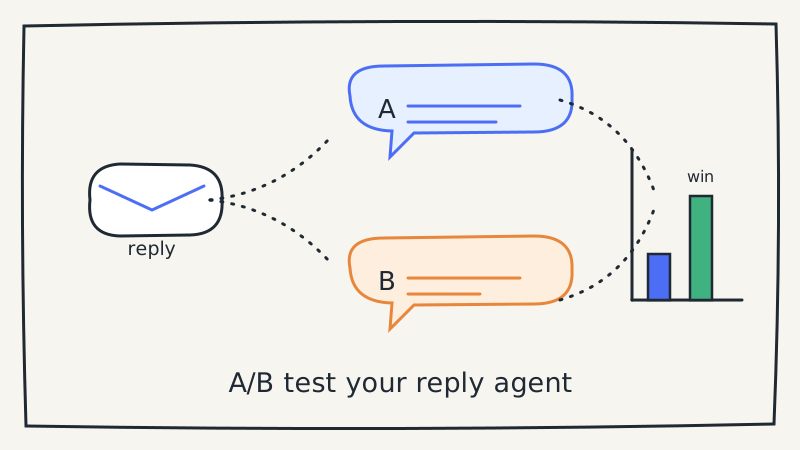
How to A/B Test Your AI Reply Agent’s Responses (and Lift Reply-to-Meeting Conversion)
Most teams treat their AI reply agent like a thermostat. They set it once, walk away, and assume it is doing its job. The replies go out, some meetings get booked, and nobody looks under the hood again.
That is a mistake. Your reply agent is writing hundreds of first-touch responses a month, and small changes in how it opens, how it asks for the meeting, and how long it waits can move your reply-to-meeting rate by double digits. The only way to find those changes is to test them.
This guide walks through how to run structured A/B tests on your AI reply agent, what to measure, and how to avoid the traps that make most “tests” meaningless.
Why bother testing the agent at all
When a prospect replies to a cold email, you have a narrow window. They are engaged right now, and every hour of delay cools the thread. A Unified Inbox with AI inbox agents like Underfive closes that gap by responding in minutes instead of hours, but speed alone does not book the meeting. The words matter.
Consider two responses to the same “sounds interesting, tell me more” reply:
- Version A: “Happy to share more. Our platform helps teams like yours cut response time on inbound replies. Do you have 30 minutes this week for a walkthrough?”
- Version B: “Great to hear. Quick question before I send a wall of text: are you handling replies manually today, or do you have something in place? That will help me point you to what is actually relevant.”
Version A asks for a big commitment up front. Version B qualifies and lowers the ask. One of these will convert better for your audience, and you will not know which until you run them side by side. Guessing is not a strategy.
Step 1: Pick one variable per test
The single most common mistake is changing five things at once and declaring victory when the number goes up. If you change the opener, the call-to-action, the wait time, and the tone in the same test, you have learned nothing about which change did the work.
Test one variable at a time. Good candidates, roughly in order of impact:
- The call-to-action. Direct meeting ask versus a soft qualifying question versus offering a specific time.
- The opener. Restating their reply versus jumping straight to value versus leading with a question.
- Response timing. Instant reply versus a deliberate 15 to 30 minute delay that feels more human.
- Length. Two sentences versus a fuller paragraph.
- Tone. Formal versus casual, depending on the segment.
Start with the call-to-action. It sits closest to the outcome you care about, so it usually produces the clearest signal.
Step 2: Split traffic cleanly
To get a fair test, incoming replies need to be randomly assigned to Variant A or Variant B. Do not split by campaign, by rep, or by time of day, because those introduce bias. A campaign targeting VPs will behave differently from one targeting founders, and if Variant A only ever sees VPs, your result is polluted.
Random assignment at the reply level is the gold standard. Most serious reply-automation platforms let you define two response templates or two agent prompts and route replies 50/50 between them. If yours does not, you can approximate it by alternating assignment as replies arrive, which is close enough for most volumes.
Keep everything else identical: same audience, same time period, same offer. The only difference between the two arms should be the one variable you are testing.
Step 3: Measure the right outcome
Reply rate is a vanity metric here. Of course your agent gets a response, it is replying inside a live thread. What you actually care about is what happens next.
Track these, in priority order:
- Reply-to-meeting rate. Of the prospects who entered each arm, what percentage booked a call? This is the number that pays your salary.
- Positive-reply rate. What share continued the conversation in a genuinely interested direction, versus objecting or going cold?
- Time-to-meeting. How many message exchanges did it take to get the booking? Fewer is usually better.
- Downstream show rate. Did the meetings actually happen, or did the agent book ghosts?
That last one matters more than people expect. An aggressive call-to-action can inflate bookings while tanking show rate, which makes the “winning” variant a net loss. Always look at least one step past the immediate conversion.
Step 4: Wait for enough data before calling it
A test with 14 replies per arm is a coin flip wearing a lab coat. You need enough volume for the difference to mean something.
As a rough guide, aim for at least 100 replies per variant before you trust a result, and more if the two numbers are close. If Variant B is booking 22 percent versus Variant A’s 12 percent across 150 replies each, that gap is almost certainly real. If it is 18 versus 17 percent, keep the test running or call it a tie and move on to a bigger lever.
Resist the urge to peek and stop the moment one variant pulls ahead. Early leads swing wildly and reverse constantly. Decide your sample size before you start, then honor it.
Step 5: Roll out the winner, then test again
Once you have a clear winner, promote it to the default and immediately line up your next test. This is the part teams skip. A/B testing is not a one-time project, it is a habit. The market shifts, your audience shifts, and a call-to-action that won in Q1 can fade by Q3.
A practical cadence: run one test at a time, give each two to four weeks depending on your reply volume, and keep a simple log of what you tested and what won. Over a year, a handful of small wins compound into a reply engine that converts far better than the one you launched with.
A few traps to avoid
Testing deliverability problems instead of copy. If your replies are landing in spam or your sending domain is flagged, no amount of clever copy will save you. Clean your list and protect your domain reputation first with a tool like Scrubby so that your carefully tested replies actually reach a human inbox. A brilliant Variant B that nobody sees is not a variant, it is a rounding error.
Ignoring segment differences. A response that wins with founders may lose with procurement. If you have very different audiences, test within each segment rather than pooling them.
Over-optimizing for the open. Getting more replies to your replies feels good, but the meeting is the point. Always tie your tests back to booked, attended calls.
Never letting the agent escalate. Some threads need a human, and no variant should try to close a deal the agent cannot handle. Testing works best when your inbox agents in Underfive know when to hand off cleanly, so your experiments measure copy quality rather than the agent stumbling on edge cases it should have escalated.
The takeaway
An AI reply agent that you never tune is leaving meetings on the table. The teams that win treat their agent as a system to be improved, not a switch to be flipped. Pick one variable, split traffic cleanly, measure reply-to-meeting rather than reply rate, wait for real volume, and roll the winner forward.
Do that consistently and the same flow of cold email replies starts producing noticeably more calendar invites, without adding a single new lead to the top of your funnel. That is the quiet compounding advantage of testing what your agent actually says.