How AI Reply Agents Handle Pricing Questions Without Killing the Deal
You send 400 cold emails on Monday. By Wednesday, 38 people have replied. Nine of them ask the same question: “What does this cost?”
For most sales teams, this is the reply that creates the most internal debate. Some reps fire back a pricing PDF within minutes. Others dodge the question entirely and try to force a discovery call. Both approaches lose deals, just in different ways.
The pricing question is one of the strongest buying signals a cold email can generate. Someone who asks about cost has already moved past “not interested.” They are evaluating. They are comparing. They want to know if this is worth their time. How you respond in the next few minutes determines whether they book a call or move on to the next vendor in their inbox.
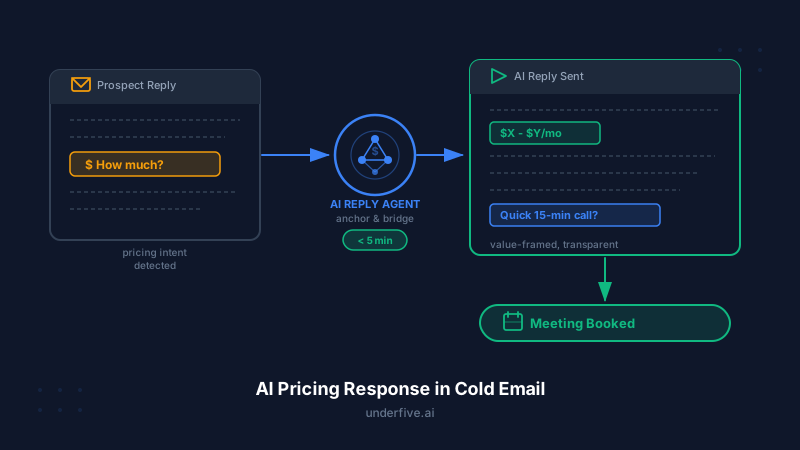
AI reply agents are built to handle this moment well. They detect pricing intent, apply the right response strategy based on context, and reply fast enough to catch the prospect while they are still engaged. This post breaks down exactly how that works, what the common mistakes look like, and how to configure guardrails that keep the conversation moving forward.
Why Pricing Questions Are a Buying Signal, Not a Threat
Sales teams that treat pricing questions as obstacles are misreading the data. A prospect who replies to a cold email with “How much does this cost?” has already done something most recipients never do: they engaged.
Consider the alternative replies a cold email typically generates. “Not interested.” “Remove me from your list.” “We already use something for this.” Those are objections. A pricing question is the opposite. It says: I am interested enough to want the next piece of information I need to make a decision.
Research on cold email reply patterns consistently shows that pricing inquiries convert to meetings at a higher rate than almost any other reply type. The prospect is self-qualifying. They are telling you they have a problem, they think you might solve it, and they want to know if the economics work.
The danger is not the question itself. The danger is the response.
The Two Ways Sales Teams Kill the Deal
There are two classic mistakes teams make when a prospect asks about pricing in a cold email thread, and both are deal-killers.
Mistake 1: Sending a Price Sheet Too Early
The instinct is understandable. The prospect asked a direct question, so give them a direct answer. Drop a pricing page link, attach a PDF, or list out the tiers.
Here is why this backfires: without context, every price looks too high. The prospect has no frame of reference for the value they would get. They have not heard about outcomes, seen a demo, or understood how the product applies to their specific situation. You are giving them a number and asking them to evaluate it in a vacuum.
What happens next is predictable. They compare your number to a competitor’s number (also without context), decide it is too expensive, and never reply again. You turned a warm prospect into a closed-lost lead with a single email.
Mistake 2: Stonewalling the Question
The other extreme is equally damaging. The prospect asks about pricing and you reply with: “Great question! I’d love to set up a quick call to learn more about your needs so I can put together a custom quote.”
This reads as evasive. The prospect hears: “I won’t tell you the price until I get you on a call where I can pressure you.” It creates friction and erodes trust. Many prospects simply stop replying because the conversation feels like it is being manipulated rather than advanced.
The problem is not that you are trying to get a meeting. The problem is that you gave the prospect zero new information in exchange for their engagement. They asked a question. You responded with a redirect. That is not a conversation; it is a gate.
How AI Reply Agents Detect Pricing Intent
Before crafting a response, an AI reply agent needs to correctly identify that a pricing question is actually a pricing question. This sounds obvious, but pricing intent shows up in different forms and each form signals a different level of urgency.
Direct price requests. “How much does this cost?” or “What’s your pricing?” or “Can you send me your rates?” These are explicit and easy to classify. The prospect wants a number.
Comparison-framed questions. “How does your pricing compare to [Competitor]?” or “Is this in the same ballpark as what we’re paying for [Current Tool]?” These signal that the prospect is actively benchmarking. They are further along in evaluation than someone asking a general price question.
Budget-fit inquiries. “Does this work for a team of 5?” or “Do you have a plan for startups?” or “Is there a minimum commitment?” These are not asking for a price directly, but they are probing whether the economics are even feasible. The intent is the same.
Embedded pricing signals. Sometimes the pricing question is buried inside a longer reply: “This looks interesting, we might be interested, what kind of budget should I be thinking about?” The AI agent needs to catch the pricing intent even when it is not the primary sentence in the reply.
Underfive runs this classification on every inbound reply within minutes of receipt. The system identifies the pricing signal type, assesses the prospect’s apparent stage in the evaluation process, and routes to the appropriate response strategy automatically.
The Right Way to Respond: Deflecting to a Meeting Without Being Evasive
The best pricing responses share a common structure. They acknowledge the question directly, provide enough information to demonstrate transparency, and then offer a meeting as the logical next step rather than a gatekeeping tactic.
Here is what that looks like in practice.
The Anchor and Bridge
This strategy gives the prospect a reference point (the anchor) and then bridges to a conversation.
“Our pricing starts at $X/month for most teams at your size, but the actual number depends on a couple of things like volume and how you’re integrating it with your current stack. Happy to walk through a quick estimate on a 15-minute call so you have real numbers to work with. Does Thursday or Friday work?”
What makes this effective: the prospect got a number. They are not in the dark. But the number is a starting point, not a final quote, which naturally creates a reason to talk further. The meeting is positioned as a service (“so you have real numbers”) rather than a sales tactic.
The Value Frame
This approach works when the product’s pricing requires context to make sense.
“Depends on the setup, but most teams like yours end up in the $X-Y range per month. The bigger question is usually what that replaces on your end. Teams we work with typically cut [specific cost or time] by [specific amount], which is where the ROI math gets interesting. Want to do a quick 15-minute call to see if the numbers make sense for your situation?”
This response does not avoid the price. It provides a range and then reframes the conversation around value, making the meeting about ROI rather than just cost.
The Comparison Redirect
For prospects who frame pricing around a competitor, this response validates the comparison while steering toward a conversation.
“We’re generally in a similar range to [Competitor] for base pricing. Where it tends to differ is in [specific differentiator that affects total cost]. Worth a quick call to compare apples to apples. I can also share what a couple of teams who switched from [Competitor] ended up paying. Would next week work?”
This positions the meeting as a way to get better competitive intelligence, which the prospect already wants.
Good Versus Bad Responses: A Side-by-Side View
Here is the same pricing question handled three ways.
Prospect reply: “This looks interesting. What does it cost for a team of about 20 people?”
Bad response (price dump): “Here’s a link to our pricing page: [link]. Let me know if you have questions.”
This gives the prospect everything they need to disqualify you and nothing they need to move forward. No context, no value framing, no next step.
Bad response (stonewall): “I’d love to learn more about your team’s needs before putting together pricing. Can we schedule a quick call?”
This ignores the question entirely. The prospect asked about cost and received zero pricing information. Trust erodes.
Good response (anchor and bridge): “For a team of 20, most clients land in the $X-Y/month range depending on usage and which features you need. I can put together a more specific estimate if we do a quick 15-minute walkthrough. I’ll also share how a similar-sized team set things up. Does Tuesday or Wednesday work?”
The prospect got a number, a reason to talk, and a clear next step. The meeting feels like a natural continuation, not a trap.
Configuring Guardrails for Pricing Responses
AI reply agents are only as good as the rules governing them. For pricing questions specifically, you need to configure several guardrails to keep responses on-strategy.
Price range boundaries. Define the floor and ceiling the agent can reference. You do not want an AI agent quoting $500/month when your actual minimum is $2,000. Set explicit ranges per product tier and per company size.
Competitor mention rules. If a prospect asks how pricing compares to a specific competitor, the agent needs guidance on what it can and cannot say. Some teams allow direct comparisons; others prefer to acknowledge the competitor and pivot. Define this in your response rules.
Escalation triggers. Certain pricing questions should go to a human. Enterprise prospects asking about custom contracts, prospects referencing specific procurement processes, or anyone mentioning legal review. Build these triggers so the agent routes the reply to a rep instead of handling it autonomously.
Meeting link delivery. When the agent successfully bridges to a meeting request, it needs to include scheduling options. Tools like Kali integrate directly into the reply flow so the prospect can book a time without a back-and-forth scheduling thread. Reducing friction at this step matters; every extra email in the scheduling process is a chance for the prospect to lose interest.
Reply validation. Before any pricing-related reply goes out, the agent should validate that the prospect’s email address is real and the conversation is genuine. Scrubby handles email validation at the list level before outreach even begins, which means the replies flowing in are from verified addresses, not spam traps or dead inboxes. This keeps your AI agent focused on real conversations instead of wasting cycles on bad data.
The Speed Factor in Pricing Replies
The timing of a pricing reply matters more than most teams realize. When a prospect sends a pricing question, they are in evaluation mode. They might be comparing three vendors right now, in this browser session, in this hour. The first vendor who gives them useful pricing information and a clear next step has a significant advantage.
Wait four hours and the prospect has moved on to other work. Your reply lands as an interruption to a different mental state, not a continuation of the conversation they started.
Underfive processes every inbound reply within five minutes, regardless of volume or time zone. For pricing questions, where the prospect is actively evaluating and the window for engagement is narrow, that speed differential compounds into measurable conversion improvements.
Making Pricing Your Competitive Advantage
Most sales teams treat pricing questions as a problem to manage. The best teams treat them as the highest-intent signal in their pipeline.
When an AI reply agent handles pricing well (fast, transparent, value-framed, with a clear next step), it converts a moment of curiosity into a booked meeting. When it handles pricing poorly, it burns a prospect who was ready to move forward.
The difference comes down to configuration: setting the right price ranges, defining response strategies by context, building in scheduling tools, and ensuring every reply goes out in minutes rather than hours.
Pricing questions are not the enemy. Bad pricing responses are. Get the reply right and the deal moves forward.