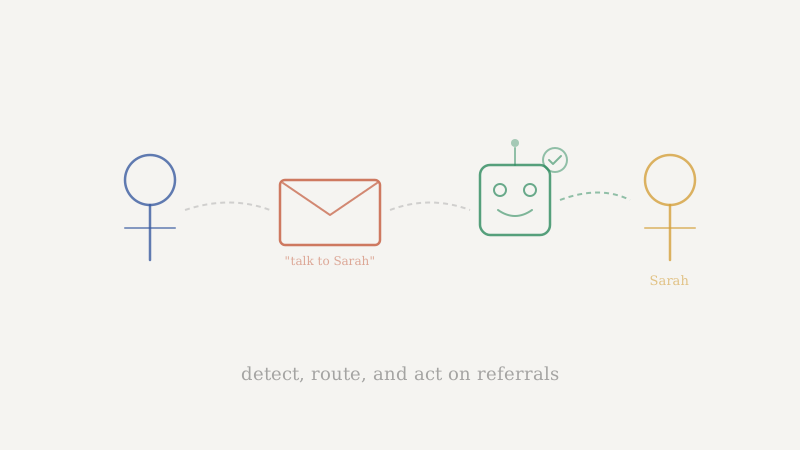
How AI Reply Agents Should Handle Referral Replies and Warm Introductions
A prospect replies to your cold email with seven words: “You should talk to Sarah in procurement.” That reply is worth more than a hundred opens. It is an explicit signal of relevance (they did not ignore you), a warm introduction (Sarah now has social proof from a colleague), and a navigation shortcut past the gatekeeper.
Most sales teams handle this manually. The SDR reads the reply, searches for Sarah on LinkedIn, drafts a personalized email referencing the introduction, and sends it within a few hours. This works when volume is low. When your outbound operation is generating dozens of referral replies per week across multiple SDRs and campaigns, manual handling introduces delays, inconsistencies, and dropped handoffs.
AI reply agents can detect referral patterns, extract the relevant contact information, and initiate the right follow-up sequence within minutes. But only if they are configured to recognize the nuance that makes referral handling different from every other reply type.
Why Referral Replies Require Special Handling
Referral replies are categorically different from other cold email responses. They are not objections (“not interested”), they are not scheduling responses (“sure, how about Tuesday”), and they are not information requests (“tell me more about pricing”). They require a completely different response workflow.
The original contact is not the prospect. When someone refers you to a colleague, the conversation with them is essentially complete. They have done what they are going to do. Your AI agent should not continue the original sequence or send follow-ups to this person as if they are still a prospect. They are now a referral source, which requires a different relationship cadence.
The referred contact has implicit social proof. When you reach out to Sarah and mention that her colleague suggested you connect, you are not sending a cold email. You are sending a warm email with built-in credibility. The messaging, tone, and urgency should all reflect this warmer starting point.
Speed matters more than with cold outreach. The window of relevance for a referral is narrow. If Sarah’s colleague mentioned your outreach in a hallway conversation or Slack message, Sarah might be expecting to hear from you. Every hour of delay reduces the connection between the introduction and your outreach. An AI reply agent that processes referrals in minutes rather than hours preserves that connection.
The referral source may expect acknowledgment. Some prospects who refer you to a colleague expect a brief thank-you or confirmation that you followed up. Ignoring the referral source after they helped you is a relationship failure that AI should prevent, not cause.
Detecting Referral Patterns
The first challenge is recognizing that a reply contains a referral. Referral language is highly varied and often informal.
Common patterns your AI reply agent should detect:
- Direct referrals: “Talk to Sarah,” “Reach out to John in marketing,” “You want Sarah.Jones@company.com”
- Redirect referrals: “I’m not the right person, try the procurement team,” “This sits with our VP of Ops”
- CC referrals: The prospect replies and CCs a colleague with a note like “looping in Sarah who handles this”
- Forward signals: “I’ll forward this to my team,” “Let me pass this along to the right person”
- Passive referrals: “Our IT director handles vendor decisions,” “This would go through our operations lead”
Each pattern type requires a different response. A direct referral with a name and email is immediately actionable. A passive referral with only a title requires research before follow-up.
Configuring the Response Workflow
Step 1: Acknowledge the Referral Source
Within minutes of detecting a referral reply, your AI agent should send a brief acknowledgment to the original contact. This message should thank them for the direction, confirm that you will reach out to the referred person, and close the loop gracefully.
The acknowledgment should be 2 to 3 sentences maximum. Do not pitch the referral source again. Do not ask for additional information unless the referral was too vague to act on (e.g., “talk to someone in ops” with no name or email).
Step 2: Research the Referred Contact
If the referral includes a full name and email, you can move directly to outreach. If it includes only a name and department, your agent needs to identify the right contact.
This is where data quality matters. Before sending your first message to the referred contact, verify the email address. Running it through Scrubby ensures you are not sending your warm introduction to an invalid address or a catch-all domain where it might never reach the intended recipient. A bounced referral email is worse than a bounced cold email because you have already consumed the social proof and cannot easily recreate it.
Step 3: Craft the Referral Outreach
The message to the referred contact should follow a specific structure that leverages the warm introduction:
Lead with the connection. The first sentence should name the referral source and establish the context. “Alex from your engineering team suggested I reach out to you” immediately differentiates this from cold outreach.
Reference the original conversation briefly. One sentence explaining what you discussed with the referral source gives Sarah context without making her feel out of the loop.
Make a specific, low-friction ask. The referred contact did not opt into this conversation. Even though the introduction is warm, the ask should respect that they are being contacted without their direct initiative. A question about timing or relevance works better than a demand for a meeting.
Keep it short. Referral emails should be shorter than cold emails. The social proof does the heavy lifting. Three to five sentences is ideal.
Step 4: Route to the Right Sequence
After the initial referral outreach, the referred contact should enter a sequence designed for warm leads, not your standard cold sequence. The follow-up cadence should be tighter (warm leads have shorter attention spans for your specific outreach), the messaging should continue referencing the introduction, and the escalation path should be different.
If you are running outbound through Vendisys, configure a dedicated referral sequence that your AI agent can route contacts into automatically. This prevents referred contacts from receiving generic cold follow-ups that ignore the warm context.
Handling Edge Cases
The Vague Referral
“This would be a decision for our operations team.”
No name, no email, no specific person. Your AI agent should respond to the referral source with a brief, specific question: “Thanks for pointing me in the right direction. Do you happen to know who on the operations team would be the best person to connect with?” This follow-up has a high response rate because the referral source has already shown willingness to help.
The CC Introduction
The prospect CCs a colleague directly. This is the warmest possible referral because the colleague can see the full thread. Your AI agent should respond to the thread (Reply All), acknowledge both the referral source and the new contact, and make the conversation about the new contact’s perspective.
Do not remove the original contact from the thread. The CC was intentional and the social proof works partly because the referral source remains visible in the conversation.
The “I’ll Forward This” Promise
“Let me pass this along to the right person.”
This is a promise, not a completed referral. Your AI agent should acknowledge the response, express appreciation, and then set a follow-up reminder. If no new contact emerges within 5 to 7 business days, send a gentle check-in to the original contact asking if they were able to connect you.
The Multi-Person Referral
“You should talk to Sarah for the technical side and James for budget approval.”
Multiple referrals from a single reply require separate, tailored outreach to each person. Each message should reference the same introduction but address different concerns relevant to each person’s role.
Measuring Referral Handling Performance
Track these metrics to evaluate how effectively your AI reply agent handles referrals:
- Referral detection rate: What percentage of referral replies are correctly identified? Audit manually by reviewing a sample of replies classified as “other” to find missed referrals.
- Time to first contact: How quickly does the AI agent send the first message to the referred contact after the referral reply? Under 30 minutes is the target.
- Referral-to-meeting conversion rate: What percentage of referral outreach results in a booked meeting? This should be 3 to 5 times higher than your cold outreach conversion rate. If it is not, your referral messaging needs work.
- Referral source satisfaction: Are referral sources responding positively to your acknowledgment messages? Negative responses or unsubscribe requests signal that your agent is handling the relationship poorly.
Tools like Kali can help book meetings directly from referral conversations through calendar invite outreach, shortening the path from warm introduction to scheduled conversation.
Do Not Waste Warm Introductions
Referrals are the highest-converting lead source in B2B sales, and they are the easiest to mishandle when processed manually at scale. An AI reply agent configured for referral detection and routing ensures that every warm introduction gets the fast, contextual follow-up it deserves.
Configure the detection patterns. Build the acknowledgment and outreach workflows. Route to warm sequences. Underfive handles the speed and consistency; you set the strategy.
Every referral reply is someone vouching for the relevance of your outreach. Do not let that signal go to waste because it sat in an inbox for three days while your team was busy with other replies.