How to Use AI Reply Agents to Rescue Dead Cold Email Threads
Your sales team sent 3,000 cold emails last month. They got 120 replies. Of those, 45 were positive or neutral. Your SDRs followed up on the positive ones, booked some meetings, and moved on to the next batch of fresh prospects.
What happened to the other 75 replies? The “let me check with my team” messages. The “interesting, send me more info” responses. The “not right now but maybe next quarter” brush-offs. In most sales organizations, those threads die. The SDR marks them as “nurture,” moves on, and never circles back with the right message at the right time.
Those dead threads represent the highest-ROI opportunity in your outbound pipeline, and AI reply agents are the tool that makes it practical to work them at scale.
Why Dead Threads Are More Valuable Than New Prospects
Cold outbound is a numbers game, but the numbers are not all equal. A prospect who has already replied to your email, even with a lukewarm response, is fundamentally different from a prospect who has never engaged.
They already know who you are. The initial awareness barrier is cleared. Your company name, your value proposition, and your SDR’s name exist somewhere in their memory. A follow-up email does not start from zero.
They expressed some level of interest. Even a “not right now” reply indicates that the prospect read your email, considered it, and took the time to respond. That puts them in the top 5 percent of engagement compared to the 95 percent who never opened or replied.
The timing was wrong, not the fit. Most stalled threads die because of timing. The prospect was mid-quarter and could not evaluate new tools. They were in a budget freeze. They were dealing with a hiring surge. Three months later, the situation may have changed entirely, but nobody followed up to find out.
Re-engagement costs a fraction of new prospecting. You have already paid for the contact data, validated the email address, and invested in the initial sequence. Reviving that thread costs one well-crafted email. Replacing it with a new prospect costs the full acquisition cycle again.
What AI Reply Agents Actually Do
An AI reply agent is not a simple drip sequence with a timer. It is a system that analyzes the context of a stalled conversation and generates a follow-up that acknowledges what happened, adds new value, and creates a reason to re-engage.
Here is how the process works:
Thread analysis. The agent reads the full conversation history: the original outreach, the prospect’s reply, any follow-up exchanges, and the point where the conversation stalled. It identifies the prospect’s stated objection or interest signal and the time elapsed since last contact.
Context enrichment. Before generating a reply, the agent pulls in fresh context. Has the prospect’s company announced anything new? Did they post on LinkedIn? Did they hire for a relevant role? Has their competitor made a move that changes their priorities? This enrichment transforms a generic “just checking in” follow-up into something the prospect actually wants to read.
Personalized message generation. Based on the thread history and enriched context, the agent drafts a follow-up that references the original conversation specifically. If the prospect said “we are evaluating tools next quarter,” the follow-up arrives at the start of that quarter with relevant context. If they said “send me more info,” the follow-up includes a specific resource tied to the pain point they mentioned.
Timing optimization. The agent does not just generate the message; it determines when to send it. Factors include time since last touch, day of week, time of day, and any calendar signals (end of quarter, after a funding round, post-conference). A well-timed re-engagement email to a stalled thread converts at 3 to 5x the rate of a randomly timed follow-up.
Setting Up AI Reply Agents for Dead Thread Recovery
Here is the practical workflow for implementing this in your sales process.
Step 1: Define What Counts as a “Dead Thread”
Not every unanswered email is a dead thread worth reviving. Set clear criteria:
- The prospect replied at least once (indicating initial engagement)
- The conversation has been inactive for 14 or more days
- The prospect did not explicitly opt out or say “not interested”
- The prospect’s email address is still valid (re-verify before sending, as addresses can go stale in weeks)
For re-verification, especially on catch-all corporate domains, run your stalled contact list through Scrubby before launching recovery sequences. There is no point crafting a perfect re-engagement email if the mailbox no longer exists.
Step 2: Categorize Stalled Threads by Signal Type
Different stall patterns require different re-engagement approaches:
Timing objection threads. “Not right now,” “check back in Q3,” “we just renewed our current contract.” These prospects told you when to come back. Your AI agent should calendar the follow-up to arrive at that moment with fresh context.
Information request threads. “Send me more details,” “interesting, what does pricing look like?” These prospects asked for something and your team either sent it with no follow-up or never sent it at all. The re-engagement should acknowledge the gap and deliver the requested information with a clear next step.
Internal approval threads. “Let me run this by my VP,” “I need to check with procurement.” The prospect was interested but needed buy-in from someone else. The re-engagement should offer to help with the internal sell: a one-pager for their VP, an ROI calculator, or a brief call that includes the decision-maker.
Ghosted after positive signal. The prospect said something encouraging, you replied, and they disappeared. This is the most common dead thread pattern. The re-engagement should introduce a new angle or piece of value rather than repeating the same ask.
Step 3: Build Context-Aware Follow-Up Templates
AI reply agents work best when given a framework to operate within. Create template structures for each signal category, then let the AI personalize the details.
For timing objection threads:
The agent references the original timeline the prospect mentioned, acknowledges that the timeframe has arrived, and introduces one new piece of context (a case study, a product update, or a market shift) that makes the conversation fresh rather than stale.
For ghosted threads:
The agent shifts the angle entirely. If the original outreach led with a pain point, the re-engagement leads with social proof. If the original led with ROI, the re-engagement leads with a competitive insight. The key is that the prospect sees something new, not a reminder of something they already ignored.
Step 4: Layer in Multi-Channel Re-Engagement
Email alone may not break through on a stalled thread. The prospect has already demonstrated that they do not prioritize your emails highly enough to respond.
Combine AI-generated email follow-ups with calendar-based outreach. Send a brief calendar invite for a 15-minute catch-up using Kali on the same day as your email follow-up. Calendar invites appear in a different attention stream than email, and prospects who ignore follow-up emails will often accept or at least view a calendar invite, especially one that references a previous conversation.
Step 5: Measure Recovery Metrics Separately
Dead thread recovery should be tracked as its own channel with its own metrics. Do not blend these numbers with your fresh outbound metrics, because the baselines are fundamentally different.
Key metrics for dead thread recovery:
- Recovery reply rate: percentage of re-engaged threads that produce a new reply. Target: 8 to 15 percent (compared to 2 to 4 percent for fresh cold outreach)
- Recovery to meeting rate: percentage of recovered threads that convert to a booked meeting. Target: 20 to 30 percent of positive recovery replies
- Time to recovery: average days between re-engagement send and prospect reply
- Revenue attribution: pipeline and revenue generated from recovered threads versus fresh outbound
How Volume Changes the Math
The real power of AI reply agents becomes clear at scale.
Consider a sales team that sends 5,000 cold emails per month and generates 200 replies. Of those, 60 convert to meetings and the rest stall. Without AI reply agents, those 140 stalled threads are written off. Over a year, that is 1,680 stalled threads sitting in your CRM, untouched.
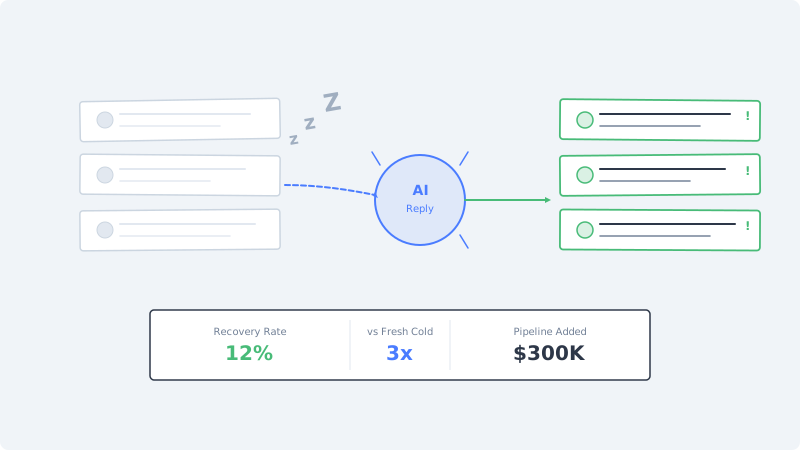
With AI reply agents recovering 12 percent of stalled threads and converting 25 percent of those recoveries to meetings, you add 50 meetings per year from contacts you have already paid to acquire. At a $30,000 average deal size and 20 percent close rate, that is $300,000 in pipeline from what would have been dead leads.
The cost to recover those threads is negligible compared to the cost of generating 50 fresh meetings through new outbound.
Common Mistakes in Dead Thread Recovery
Sending “just checking in” messages. This is the single most common and least effective re-engagement approach. It adds no value, demonstrates no awareness of the prospect’s situation, and signals that you have nothing new to offer. AI reply agents exist specifically to eliminate this pattern.
Re-engaging too soon. If a prospect went silent five days ago, they are not a dead thread. They are busy. Wait at least 14 days, often 21 to 30 days, before classifying a thread as stalled. Premature follow-ups feel pushy and reduce your chances of eventual conversion.
Ignoring deliverability on re-engagement sends. Just because an email was valid three months ago does not mean it is valid today. People change jobs, companies restructure, and mailboxes get deactivated. Always re-validate before sending recovery sequences.
Not coordinating with competitor intelligence. If a prospect went silent because they chose a competitor, a generic follow-up will not work. But if you know their competitor just raised prices or had a service outage, that context transforms your re-engagement into a genuinely useful touchpoint. Tools like CAM surface these competitive signals automatically, giving your AI reply agent the context it needs to craft relevant follow-ups.
Start With Your Existing Dead Threads
You do not need to build a complex system to start recovering dead threads. Export your stalled conversations from the past 90 days, categorize them by signal type, and run a targeted recovery campaign. Even a manual first pass will demonstrate the ROI before you invest in full automation.
The threads are already in your CRM. The prospects already know your name. The only thing missing is the follow-up that gives them a reason to reply.