Cold Email Open Rate vs Reply Rate: Why Opens Lie in 2026 and Replies Don’t
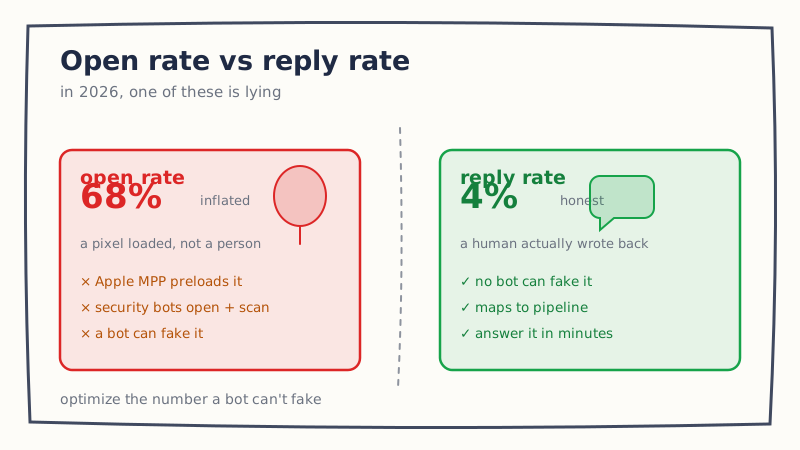
Your last campaign shows a 68% open rate and you feel great about it. Then you check the inbox and there are four replies out of 500 sends. Something does not add up, and it is not your subject line. In the cold email open rate vs reply rate debate, one of those two numbers is quietly lying to you, and in 2026 it is almost always the open rate.
This matters because teams still make real decisions on open rate: they pause “low-open” sequences, rewrite subject lines that were fine, and declare campaigns healthy when the pipeline says otherwise. This post explains exactly why open rate became unreliable, why reply rate is the metric that actually maps to revenue, and how to run your outreach around replies instead of vanity opens.
What open rate and reply rate actually measure
The two metrics answer different questions, and conflating them is where most teams go wrong.
- Open rate is meant to measure how many recipients opened your email, calculated as opens divided by delivered. It is tracked with a tiny invisible image (a tracking pixel) that loads when the email is displayed. If the pixel loads, the tool records an open.
- Reply rate measures how many recipients actually wrote back, calculated as unique replies divided by delivered. A reply is a human deciding you were worth a response.
The gap between them is the gap between “a pixel loaded” and “a person engaged.” One of those is trivially easy to fake or trigger by accident. The other is not. That difference is the whole argument.
Why cold email open rate is unreliable in 2026
Open rate did not slowly drift out of accuracy. It was structurally broken by two changes, and both of them inflate the number in a direction that flatters you.
Apple Mail Privacy Protection loads the pixel for everyone
Apple Mail Privacy Protection (MPP) routes incoming mail through Apple’s proxy servers, and those servers preload the tracking pixel whether or not the recipient ever opens the message. Your tool sees the pixel fire and counts an open. The person may never have looked at it.
This is not a fringe edge case. Apple Mail is one of the most common email clients among business recipients, and MPP is on by default. Email service providers that studied the rollout reported open rates climbing sharply once MPP took hold, in some analyses nearly doubling for audiences heavy in Apple Mail users. When a large share of your list has their opens machine-generated, your open rate stops being a measure of human attention and becomes a measure of how many Apple users are on your list.
Security bots open and click before your prospect ever sees the email
The second inflator is corporate security. Email security gateways, link scanners, and spam filters routinely open messages and pre-fetch every link to check for threats before delivering to the human. That process trips your tracking pixel and can register phantom clicks too. The more “enterprise” your target accounts are, the more of this bot activity you get, which means your best-fit prospects generate some of your least trustworthy open data.
Put those two forces together and the conclusion is unavoidable: a high open rate in 2026 can mean Apple preloaded your pixels, a security appliance scanned your links, or an actual human read your email, and open rate alone cannot tell you which. That is why optimizing subject lines purely on open rate is chasing a number that no longer measures what you think it measures.
Why reply rate is the metric that survives
Reply rate does not have this problem, and the reason is simple. No proxy server, security bot, or privacy feature writes a genuine reply for the prospect. A reply requires a human to read enough of your message to react, form an opinion, and type something back. It is a costly signal, and costly signals are the trustworthy ones.
Reply rate also sits much closer to revenue on the metric chain:
- Opens tell you a pixel fired.
- Clicks tell you something got fetched, sometimes by a bot.
- Replies tell you a real person is now in a conversation with you.
- Positive replies tell you that person is interested.
- Meetings tell you the pipeline is real.
Every step down that list is harder to fake and worth more. Reply rate is the first step on the list that a machine cannot manufacture on your behalf, which is exactly why it belongs at the center of your reporting. If you want to go one level deeper, the metric that correlates best with pipeline is not raw replies but positive replies, which we break down in the positive reply rate guide.
Cold email open rate vs reply rate: a side-by-side
| Question | Open rate | Reply rate |
|---|---|---|
| What triggers it | A pixel loads | A human writes back |
| Can a bot fake it | Yes, routinely | No |
| Distorted by Apple MPP | Heavily inflated | Not affected |
| Distorted by security scanners | Yes | No |
| Maps to pipeline | Weakly | Strongly |
| Worth optimizing in 2026 | As a rough directional signal at best | Yes, as your primary metric |
The honest read is not “never look at open rate.” It is “stop treating open rate as ground truth, and never make a keep-or-kill decision on it.” Use it, if at all, as a loose directional hint that a segment is deliverable, and put reply rate in charge of every real decision.
How to run outreach around reply rate instead of opens
Deciding reply rate matters is easy. Actually operating on it is where teams fall down, because a reply-first operation demands two things: measure replies correctly, and respond to them fast enough to convert. Here is how to do both.
1. Measure reply rate honestly
Calculate reply rate as unique human replies divided by emails delivered, per campaign and per segment. Two rules keep the number clean:
- Deduplicate per person. Three messages from the same prospect is one reply, not three.
- Separate real replies from noise. Out-of-office autoresponders, hard bounces, and “unsubscribe” requests are not engagement and should not pad your reply rate. Bucket them separately. If you have not built that classification yet, the cold email reply categories and triage workflow lays out the categories to start with.
2. Segment your reply rate
A single blended reply rate hides everything useful. The same campaign can pull 6% from one industry and under 1% from another, and only segmented data tells you which lists and messages to double down on. Benchmark your segments against realistic ranges rather than a single “good” number, which is why we published reply rate benchmarks by industry to compare against.
3. Respond fast, because reply rate only pays off if you convert the replies
Here is the trap that undoes most reply-focused teams. They finally start generating replies, then let those replies sit for hours in a shared inbox. A reply is a time-sensitive asset. Contacting an interested lead within a few minutes of their reply produces dramatically higher conversion than waiting even an hour, and we walk through the mechanics in how five-minute response times increase conversions. A reply you answer the next morning is a reply you largely wasted.
This is precisely the problem Underfive was built to solve. Instead of a pixel-based dashboard that congratulates you on phantom opens, it treats the reply as the event that matters: it reads each inbound reply, classifies intent, drafts a specific response, and answers within the window while the prospect is still paying attention. You can see how that reply-handling layer fits together on the Underfive features page.
A quick gut check for your own numbers
Pull your last campaign and run this test. If your open rate is high but your reply rate is near zero, do not assume your message was compelling and your ask was weak. Assume your opens are inflated by MPP and bots, and judge the campaign on the replies alone. If replies are thin, the fix is upstream: sharper targeting, a more relevant angle, a clearer ask, not a new subject line chasing an open rate that was never real.
Then flip it. If a segment shows a modest open rate but a strong reply rate, that segment is your winner, and any tool optimizing on opens would have told you to cut it. That is the cost of measuring the wrong thing.
The takeaway
In the cold email open rate vs reply rate question, 2026 settled the argument. Apple Mail Privacy Protection and security bots inflate opens in the exact direction that fools you into complacency, while reply rate stays honest because no machine writes a genuine reply for your prospect. Report on replies, segment them, benchmark them, and above all answer them fast. If your current stack still leads with open rate, that is the signal to rebuild your measurement, and your workflow, around the one number a bot cannot fake.
Start by recalculating your last three campaigns on reply rate alone. If the ranking of your “best” campaigns changes, you just found out how much open rate was costing you.