How AI Reply Agents Handle ‘We Don’t Have Budget Right Now’ Replies
“We don’t have budget for this right now.”
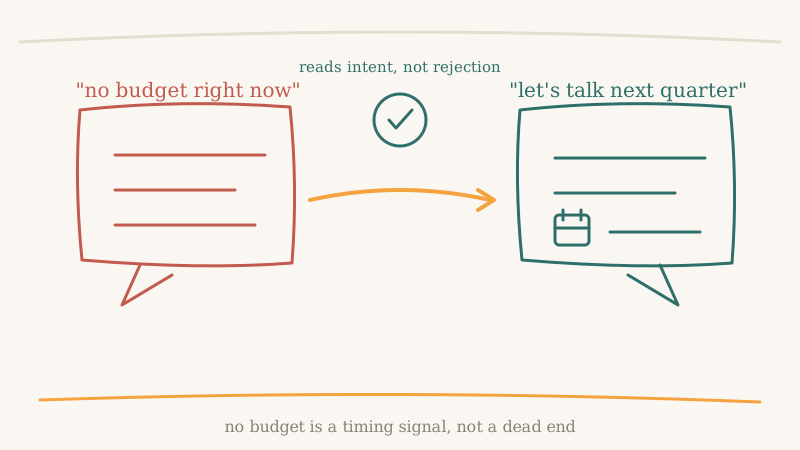
It is one of the most common replies a cold email campaign produces, and one of the most misread. Reps see the word “budget,” file it under rejection, and move on. But a budget reply is rarely a hard no. More often it is a timing statement dressed as a decline. The prospect is telling you the need might be real, the money just is not allocated this cycle.
The problem is what happens next. A busy rep marks the thread closed lost and forgets it. The prospect, who was actually half-interested, never hears from you again. Three months later their budget opens and they buy from whoever stayed in touch. That whole outcome hinges on how the reply is handled in the first few minutes after it lands.
This is exactly the kind of nuanced, high-frequency reply an AI reply agent is built to handle well.
Why budget replies get mishandled
Budget objections fail in two predictable ways, and both come from the human handling gap.
The first is misclassification. A tired rep scanning an inbox sees “no budget” and treats it identically to “not interested” or “unsubscribe.” Those are three completely different signals, and collapsing them into one bucket destroys pipeline. A no-budget prospect belongs in a nurture track with a follow-up date, not a closed-lost graveyard.
The second is the response itself. Even when a rep recognizes the opportunity, the reply they send under time pressure is often defensive or discount-first. “We can offer 20% off” trains the prospect to always claim no budget. “Can I ask what your budget is?” feels like an interrogation. The right move is subtle, and subtlety is the first thing to disappear when someone is answering forty threads before lunch.
We have written before about why cold email replies get ignored, and budget replies suffer the same fate: they arrive at the exact moment a rep has the least attention to spend on getting the nuance right.
What the reply is actually telling you
A budget objection usually carries one of three underlying meanings, and the correct response depends entirely on which one it is:
- “Not this quarter, maybe next.” The need is acknowledged, the money is on a calendar. This prospect wants a follow-up timed to their fiscal cycle.
- “You have not shown me this is worth reallocating for.” Budget exists, but you have not cleared the bar to jump the queue. This prospect needs a sharper value case, not a discount.
- “This is a soft brush-off.” Polite way of saying low priority. Worth one good re-frame, then a long-tail nurture.
A person can learn to hear these differences. The trouble is doing it consistently across every reply, at all hours, without the classification degrading when the inbox gets loud. That consistency is where automation earns its place.
How an AI reply agent handles it
Underfive’s Unified Inbox reads a budget reply the moment it arrives and does three things a rushed human often skips.
First, it classifies the intent correctly. The agent distinguishes “no budget this quarter” from “not interested” from “wrong person,” because those trigger completely different playbooks. A timing objection routes to a nurture sequence with a dated follow-up. A hard no is respected and closed. The prospect is never mislabeled just because the inbox was busy.
Second, it responds without discounting. Instead of reaching for a price cut, the agent acknowledges the timing, asks a light qualifying question about when budget typically gets set, and offers something low-commitment: a short resource, a benchmark, or a note to reconnect at a specific date. It keeps the relationship warm without cheapening the product.
Third, it schedules the future. This is the part humans forget most. When a prospect says “circle back in Q1,” that promise is worth nothing unless someone actually circles back. The agent sets the follow-up, remembers the context of the original thread, and re-engages on time with continuity instead of a cold restart. If you want the mechanics of that, we covered how agents rescue dead cold email threads and re-engage prospects in a separate piece.
A sample exchange
Here is the difference in practice.
Prospect: “Appreciate the note but we have no budget for new tools right now.”
Typical rushed reply: “No problem, would a discount help?” (Trains the prospect to always claim no budget, and signals your price was inflated to begin with.)
AI reply agent: “Totally understand, budget timing is real. Out of curiosity, when does your team usually plan tooling spend for the next cycle? Happy to send over a short benchmark now so it is on your radar, and I can check back closer to that window rather than bugging you before it is useful.”
The second reply respects the timing, gathers a genuinely useful data point (the budget cycle), delivers value, and sets up a properly timed return. No discount, no pressure, no dead thread.
Where budget replies fit in the bigger picture
Handling one objection well is a small win. Handling every objection type consistently, across every campaign, is a pipeline advantage. Budget replies sit alongside pricing questions, competitor mentions, and timing brush-offs as the everyday texture of a cold inbox. An agent that handles all of them with the same care is what turns a noisy inbox into a predictable source of meetings.
Two things make the budget playbook actually work in practice. The first is list quality upstream: budget objections from real, engaged buyers are worth nurturing, but the same reply from a mistyped or invalid contact is just noise. Running your list through a validation tool like Scrubby before the campaign means the replies you spend effort nurturing are from people who can actually buy.
The second is a clean path from “yes, next quarter” to a booked slot when the time comes. When a nurtured prospect finally raises their hand, a calendar-first tool like Kali removes the back-and-forth and locks in the meeting while the intent is fresh, so the patient follow-up does not stall at the finish line.
The takeaway
A no-budget reply is one of the most valuable messages in your inbox, precisely because most of your competitors throw it away. The prospect has told you the need may be real and given you a rough timeline. All that is left is to read the signal correctly, respond without discounting, and actually follow up on schedule.
That is a lot to ask of a human doing it forty times a day. It is exactly what the inbox agents in Underfive’s Unified Inbox do every time, at any hour, without letting a warm timing signal cool into a closed-lost line item.