How AI Reply Agents Handle Competitor Mention Replies in Cold Email
You send 500 cold emails on a Tuesday morning. By Thursday, 47 people have replied. Twelve of them say some version of the same thing: “We’re already using [Competitor].”
In a manual outreach workflow, those 12 replies sit in a queue until a rep gets to them — sometimes hours later, sometimes the next day. By then, the window has mostly closed. The prospect has moved on mentally, and the reply feels like an interruption rather than a conversation.
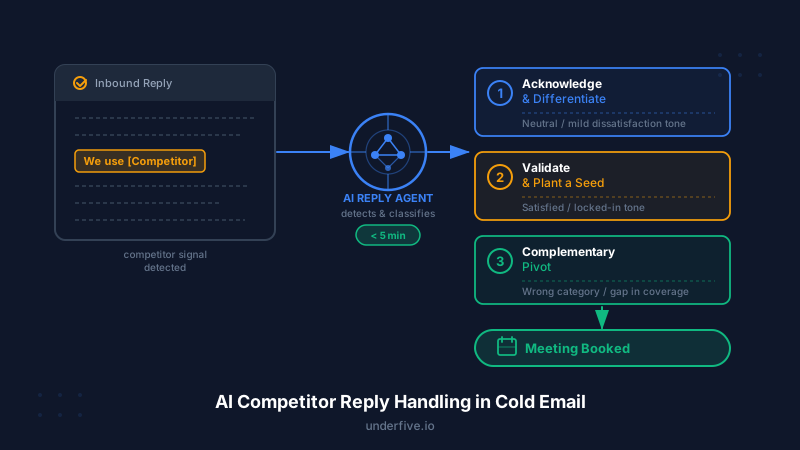
An AI reply agent working alongside your outbound motion doesn’t have this problem. It reads the competitor mention, identifies the context, selects the right response strategy, and sends a thoughtful reply within minutes. Not a template blast. A reply that acknowledges the relationship, surfaces a differentiated angle, and offers a low-friction next step.
This post breaks down exactly how that works — how AI reply agents detect competitor mentions, what response strategies they use, and how the whole system connects to booking real meetings.
Why Competitor Mention Replies Are the Hardest to Handle Manually
Competitor mention replies are uniquely difficult because they aren’t a hard no. The prospect replied. They’re engaged enough to share information about their current setup. That’s a signal, not a wall.
But responding well requires more context than a standard objection. A rep handling a competitor mention needs to know:
- Which competitor the prospect mentioned and what that competitor’s known weaknesses are
- Whether the prospect’s tone suggests frustration with the competitor or satisfaction
- Whether to differentiate directly, validate the choice and plant a seed, or pivot entirely
- How aggressively to push a meeting versus letting the conversation breathe
Get this wrong and you come across as dismissive (“our product is better than theirs”) or limp (“great, let us know if you ever want to switch”). Neither moves the deal forward.
Get it right and you turn a “we already use someone” reply into a demo that the prospect actually shows up to.
The challenge for manual workflows isn’t knowing the right strategy — most experienced reps do. It’s executing it consistently across dozens of replies at the right speed, for every reply, every day.
How AI Reply Agents Detect Competitor Mentions
Before crafting a response, an AI reply agent needs to correctly classify what kind of reply it’s reading. Competitor mention detection is a classification step that happens in seconds.
The agent scans the reply for several signals:
Explicit competitor names. Direct mentions — “We use Salesforce,” “We’re on HubSpot,” “We went with Gong last year” — are the easiest to catch. The agent cross-references a known competitor list and flags the reply for the competitor-mention response strategy.
Implicit signals. Some replies mention a category rather than a brand: “We already have a solution for this” or “Our current vendor handles that.” The agent identifies these as likely incumbent-present situations and applies a softer version of the competitor response flow.
Sentiment overlay. The same competitor mention reads differently in “We use [Competitor] and honestly it’s been fine” versus “We use [Competitor] and it’s been a constant headache.” AI reply agents trained on sales context can parse this distinction and adjust the response tone accordingly — more validation-first in the first case, more solution-forward in the second.
Contextual flags. Contract timing clues (“we just signed,” “our renewal is in Q4”), team size signals (“we’re only two people in sales right now”), and budget signals (“we’re not looking to add more tools”) all shape which response path the agent takes.
Underfive processes this classification step automatically, running it against every inbound reply within minutes of receipt. The categorization feeds directly into the response strategy selection — no manual routing required.
The Three Core Response Strategies for Competitor Mentions
Once the agent has classified the reply, it selects from a set of response strategies based on the context. There are three main approaches, each suited to a different scenario.
Strategy 1: Acknowledge and Differentiate
Used when: the prospect is currently using a competitor but their tone is neutral or slightly dissatisfied.
This is the most common competitor mention scenario. The prospect isn’t unhappy enough to be actively shopping, but they’re not locked in either. The goal of the AI reply is to acknowledge that the competitor is a legitimate choice, introduce one sharp differentiation point, and offer a low-stakes next step that doesn’t feel like a pitch.
A well-crafted AI reply in this scenario might read:
“[Competitor] is a solid option for teams at your stage. Where we tend to come in is for teams where [specific pain point] has become a bottleneck — the [differentiated capability] is something most of those teams weren’t getting from their current setup. Happy to share a quick example of how one team made the switch if that’s useful — no need to make it a full call.”
What makes this work: it validates the competitor (no kneejerk competitive attack), makes exactly one differentiation claim (not a feature dump), and offers a next step calibrated to where the prospect actually is.
Strategy 2: Validate and Plant a Seed
Used when: the prospect seems satisfied with the competitor and the tone suggests they’re not shopping.
This is the scenario where pushing too hard costs you the relationship. The AI reply agent recognizes that a direct differentiation pitch will land badly and instead uses a longer-game approach: validate the current choice, establish credibility, and leave a specific re-engagement hook that gives the prospect a reason to come back when circumstances change.
A reply in this mode might read:
“Makes sense — [Competitor] is a good fit for a lot of teams. If you ever find yourself in a position where [specific scenario: renewal comes up, team scales, new use case emerges], worth a quick conversation. I’ll keep your info handy. Appreciate you taking the time to reply.”
This sounds simple but it’s doing real work. It doesn’t burn the bridge. It positions the sender as someone who isn’t desperate. And it plants a specific trigger condition — “when X happens, think of us” — rather than a vague “keep us in mind.”
Strategy 3: Pivot to a Complementary Angle
Used when: the competitor handles a different use case, there’s a clear gap in coverage, or the prospect’s mention reveals context that suggests a non-overlapping entry point.
Some competitor mentions actually reveal that the prospect has the wrong mental model of what you do. “We use [Competitor]” — but [Competitor] doesn’t actually solve the problem your product solves. The AI reply agent pivots without contradicting the prospect.
“Good to know — [Competitor] is actually focused more on [their primary use case], which is a bit different from what we do. We work specifically on [your use case], which most teams using [Competitor] still need a separate solution for. Could be worth a 15-minute call to see if there’s overlap — what does your schedule look like next week?”
This pivot strategy works particularly well when competitor intelligence is part of the system. Tools like CAM can surface real-time data on competitor positioning, common use cases, and known gaps — giving the AI reply agent accurate competitive context to draw from rather than relying on static information loaded at training time.
The Speed Factor: Why 5 Minutes Changes Everything
The timing of a reply to a competitor mention matters more than most sales teams appreciate.
When a prospect sends a reply, they’re at peak engagement. The original cold email is still fresh. They just made the mental effort to respond. Their attention is on this vendor category right now.
Wait 4 hours and that context has evaporated. They’ve moved through a dozen other tasks. Your follow-up feels like an interruption to a different mental state, not a continuation of a conversation they started.
Underfive is built around this insight: every inbound reply handled within 5 minutes, regardless of volume, time zone, or how many replies came in at once. For competitor mention replies specifically — where the window to keep the conversation going is narrow — this speed differential compounds into meaningful conversion differences.
A competitor mention replied to in 4 minutes keeps the thread alive. The same reply sent 6 hours later often gets ignored or triggers a one-word response that ends the conversation.
Feeding Competitor Intelligence Into the Agent
An AI reply agent is only as sharp as the competitor intelligence it has access to. There are two ways this typically gets structured.
Static competitive context. The agent is given a library of competitor positioning notes — known weaknesses, common objections, differentiation angles for each major competitor. This works for stable competitive landscapes and can be maintained by marketing or product.
Dynamic competitor intelligence. The agent pulls from a real-time source that tracks competitor positioning, pricing changes, customer complaints, and feature gaps. CAM is designed specifically for this — it monitors competitor signals continuously and surfaces intelligence that can be used by both human reps and automated reply agents to keep competitive responses current.
The difference matters when a competitor changes pricing, loses a key feature, or has a public trust incident. Static notes go stale. Dynamic intelligence keeps the agent’s competitor responses accurate.
From Competitor Reply to Booked Meeting
Handling the competitor mention reply well is step one. The actual goal is converting that reply into a meeting that shows up on a calendar.
This is where the handoff from AI reply to meeting booking becomes critical. Once the AI reply agent has acknowledged the competitor mention and generated interest in a next step, the prospect needs a frictionless way to actually book a time.
Connecting Underfive to a booking tool like Kali closes this loop automatically. When a prospect responds positively to the AI reply — “sure, happy to take a quick call” — the next automated message goes out with a direct booking link, not a back-and-forth email exchange trying to find a time. The meeting gets on the calendar while the prospect is still warm.
For the minority of competitor mention replies that convert directly (the prospect was already evaluating, the timing was right, the differentiation landed), this pipeline from cold reply to booked call can happen entirely without human involvement. A rep reviews the conversation after the fact to prepare for the call — not to manage the scheduling.
What Good Prospect Data Looks Like Before the Reply Agent Runs
One thing that undermines competitor reply handling before it even starts: poor list quality. If the prospect address in your outreach is a dead mailbox, your carefully crafted cold email never reached a real person, and the “competitor mention” reply you’re responding to might not be coming from the right contact at the account at all.
Pre-campaign email validation with Scrubby ensures that the prospect list your outreach is running against actually reaches real people. Catch-all addresses — common at enterprise accounts — get validated for actual deliverability rather than treated as unknowns. A clean list going into the outreach campaign means the replies coming back are from real contacts who saw the original message, which makes every downstream step — including competitor reply handling — far more productive.
Putting It Together: The Full Competitor Reply Workflow
Here’s the end-to-end flow when an AI reply agent is handling competitor mentions at scale:
- Outbound send runs against a validated prospect list (Scrubby clears the catch-alls)
- Prospect replies with a competitor mention
- Inbox agents (Underfive) classify the reply: competitor name, tone, context signals
- Response strategy selected: acknowledge/differentiate, validate/plant-seed, or complementary pivot
- Competitive context pulled from static library or dynamic intelligence (CAM)
- Reply sent within 5 minutes, personalized to the specific competitor and prospect context
- Positive response triggers booking link via Kali
- Meeting booked, rep notified with conversation thread and competitive context summary
- Rep shows up prepared — conversation history, competitor intel, prospect background all available
The whole system runs through the Vendisys ecosystem, where email validation, reply automation, competitive intelligence, and booking tools connect into a single outbound workflow rather than separate tools that require manual handoffs between each step.
The Competitive Conversation Is a Conversation Worth Having
Competitor mention replies used to be the hardest part of a cold email program to handle consistently. Too slow and you lose the thread. Too aggressive and you burn the relationship. Too passive and nothing changes.
AI reply agents change the equation — not by replacing good sales judgment, but by executing it consistently, at speed, across every reply in your pipeline. The differentiation strategy your best rep uses when they catch a competitor mention at the perfect moment becomes the standard response for every reply, every time.
That’s what Underfive does for teams running cold email at scale: it handles the reply that determines whether the competitor mention becomes a dead end or the start of a real conversation.