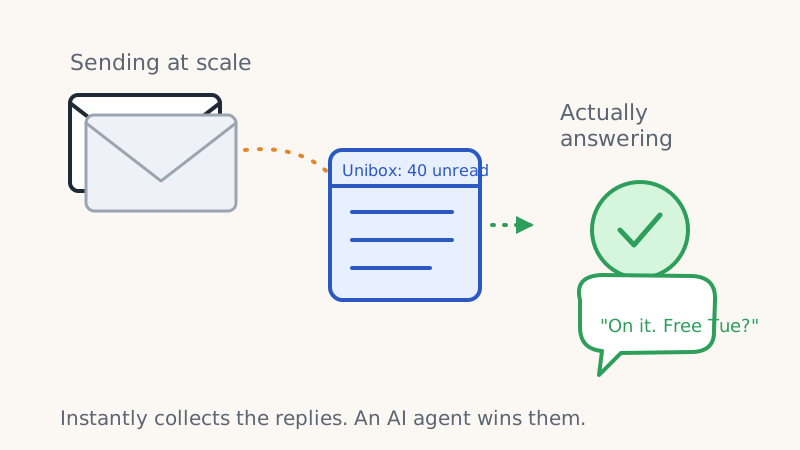
AI Reply Agent vs Instantly: Sending at Scale vs Actually Answering Replies
Instantly earned its place in the cold email stack honestly. It made high volume sending approachable, bundled inbox rotation and warmup into one product, and gave small teams the kind of deliverability infrastructure that used to require a full ops person. Its Unibox then solved a real second problem: replies scattered across a dozen sending mailboxes all land in one searchable view.
So if you already run Instantly, this is not a post about ripping it out. It is a post about a gap that opens up right after a reply arrives. Instantly is built to get your message delivered and to collect what comes back. It was never built to read that reply, understand what the prospect actually wants, and answer fast enough to keep the deal warm. That last mile is where a Unified Inbox with AI inbox agents like Underfive does a different job. This is an honest breakdown of what Instantly does well, where its role ends, and when you need an agent on the replies rather than a better sender.
What Instantly Is Genuinely Good At
Give the tool its due, because the comparison only makes sense once you are clear about what each side owns.
- Deliverability infrastructure. Mailbox rotation, automated warmup, and sending across many inboxes to protect domain reputation. This is Instantly’s core, and it is strong.
- Volume sequencing. Building multi step campaigns and pushing them to thousands of prospects without your primary domain catching fire.
- The Unibox. Every reply from every connected mailbox in one place, so your team is not logging into fifteen inboxes to find responses.
- Reply detection and basic labeling. Instantly can flag that a reply came in and sort it into buckets like interested or out of office.
That is a serious amount of value, and for the top of the funnel it is most of what you need. The trouble is that every item on that list stops at the moment a human has to think about what the reply means and type a good answer back.
Where the Job Actually Ends
Here is the quiet handoff that most teams never notice they are making. Instantly delivers the email, the prospect replies, the Unibox lights up, and then a person has to do all of the following: open the thread, read it, figure out whether it is a real buying signal or a brush off, decide what to say, write it in a way that sounds human, and send it before the prospect’s attention moves on.
Instantly does none of those six things. It was never supposed to. Detecting a reply and understanding a reply are different problems, and the second one is where deals are won or lost. A Unibox that neatly organizes forty replies you have not answered yet is not a solution, it is a very tidy backlog.
This gap has a cost, and it is measurable. Reply speed is one of the highest leverage variables in the entire funnel, and the falloff is brutal once a response sits for hours. We dug into the numbers in how five minute response times increase conversions. The short version: the tool that helped you generate the reply does nothing to help you win it, and the clock starts the second the Unibox pings.
What a Dedicated AI Reply Agent Adds
An AI reply agent starts exactly where Instantly’s job ends. It sits on the inbox and treats each reply as a conversation to be advanced, not a row to be filed. In practice that means a few concrete things.
It reads intent, not just keywords. A reply that says “we already use something for this” is not a rejection, it is an opening to differentiate. A reply asking “how are you different from X” is a buying signal wearing a skeptical hat. An agent classifies the real intent behind the words and responds to that, the way a sharp SDR would. If you want to see how this plays out on a specific case, we broke down the “we already use a competitor” reply and how to turn it into a live conversation.
It answers in minutes, at any hour. No queue, no time zone gap, no waiting for the rep to finish their morning block. This is where most of the conversion lift actually lives, because it closes the window between interest and follow up before the prospect cools off.
It handles the messy middle. Pricing questions, “send me more info,” scheduling back and forth, objections, and the polite deferrals that humans tend to fumble. The agent keeps the thread moving toward a booked meeting instead of letting it stall in a tidy inbox.
It escalates when it should. A good agent knows the difference between a reply it can answer and one that needs a human. It handles the routine volume and routes the genuinely complex or high value threads to a person with the full context attached, so nothing important gets an autopilot answer.
Instantly vs an AI Reply Agent: The Honest Split
The clearest way to see it is to line up who owns what.
- Getting delivered: Instantly. Warmup, rotation, and reputation are its home turf, and a reply agent does not try to compete there.
- Collecting replies: Instantly. The Unibox is a genuinely useful place to aggregate responses.
- Understanding replies: the AI reply agent. Reading intent and deciding what a prospect actually wants is a different capability than detecting that a reply exists.
- Answering replies fast and well: the AI reply agent. This is the whole point, and it is the part Instantly leaves to your team.
- Booking the meeting: the AI reply agent, working the conversation to a scheduled call rather than a labeled thread.
Notice that this is not an either or. Instantly and a reply agent are not fighting over the same job. They own adjacent halves of the funnel that most teams accidentally leave stitched together with manual effort.
The Setup That Actually Works
The cleanest configuration is to keep Instantly doing what it is best at and put an AI reply agent on the replies it collects. Concretely:
- Clean your list before you send. Bounces wreck the deliverability that Instantly works hard to protect, so validate your list with a tool like Scrubby so your sequences reach real inboxes and your reply data is not polluted by dead addresses.
- Let Instantly own delivery and the Unibox. Keep the warmup, rotation, and sequencing exactly as they are. There is no reason to change your sending stack.
- Put a reply agent on the inbox. Let it read, respond, and advance every reply the moment it lands, escalating the ones that need a human.
- Layer in calendar first outreach where it fits. If part of your motion is booking demos directly, pairing the reply agent with a tool like Kali keeps meetings flowing from the same top of funnel.
That arrangement gives you the best of both: Instantly’s reach and reputation on the way out, and a tireless responder on the way back in.
The Bottom Line
Instantly answers the question “did my email get delivered, and can I see every reply in one place?” That is a real and valuable question, and Instantly answers it about as well as anyone. But it is not the question your revenue depends on. The question that decides the deal is “did we respond well, and fast enough to win it?” and that is exactly what Instantly was never built to answer.
If replies are stacking up in a beautifully unified inbox while conversion quietly leaks between the reply and the response, the fix is not a better sender. You already have one. The missing piece is something built to have the conversation, which is precisely what a Unified Inbox with AI inbox agents like Underfive is for. Keep Instantly for what it is great at, and stop letting good replies go cold in the Unibox.