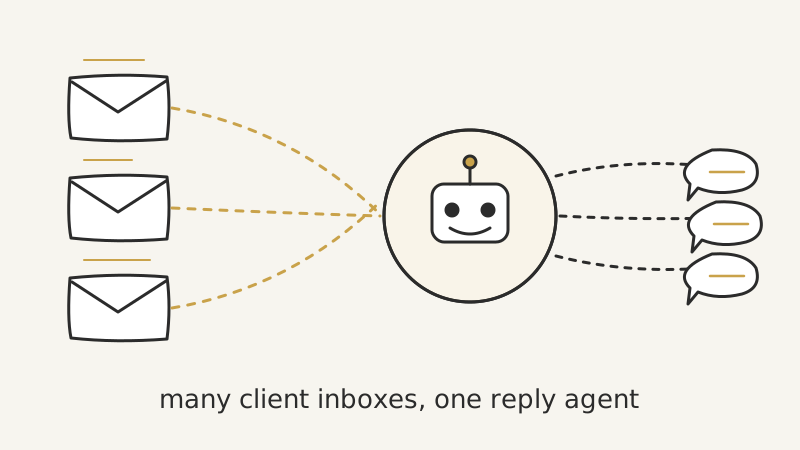
How AI Reply Agents Help Agencies Manage Cold Email Replies Across Multiple Client Inboxes
A single sales team runs one inbox and a handful of sending domains. A lead generation agency runs twenty, fifty, sometimes a hundred inboxes at once, each one belonging to a different client with a different offer, a different tone, and a different definition of a good lead. When those campaigns start working, replies arrive in a flood that no amount of manual triage can keep up with.
This is the quiet operational ceiling that caps agency growth. You can win new logos and launch new campaigns, but every new client multiplies the reply volume your team has to read, understand, and answer within minutes. Miss that window and the client sees a dead pipeline, then churns. This article breaks down why multi client reply management is so hard and how an AI reply agent changes the math.
Why Agency Inboxes Break Traditional Reply Workflows
When you manage cold email for one company, reply handling is a solvable problem. One brand voice to learn. One offer to pitch. One set of qualification criteria. Your SDR knows the product cold and can answer almost anything a prospect throws back.
Agencies do not have that luxury. Every client brings its own context, and that context does not transfer between accounts.
Context Switching Destroys SDR Throughput
An agency SDR clearing a shared queue jumps from a fintech compliance SaaS reply to a construction equipment lead to a healthcare staffing prospect in the space of three messages. Each switch forces the rep to reload the client’s offer, pricing, positioning, and disqualifiers from memory or from a doc buried in a shared drive. That cognitive reset is where speed and accuracy both collapse. A rep who could clear one client’s inbox in twenty minutes needs an hour when the same volume is spread across five accounts.
Reply Volume Scales Faster Than Headcount
Add a client and you add their entire reply stream on top of everyone else’s. Agencies try to solve this by hiring, but SDR headcount is the single largest cost line in the business and the hardest to scale predictably. You cannot hire a fractional SDR the moment a campaign heats up, and you cannot lay one off the week a client pauses. Reply volume is spiky and per client, while headcount is fixed and shared. That mismatch is where margin leaks out.
Every Client Wants a Different Voice
A cybersecurity client wants replies that sound measured and technical. A consumer brand wants warmth and speed. A private equity outreach campaign wants terse and senior. When one SDR answers for all of them, the voice blurs toward a generic middle that satisfies no one. Clients notice, and “these replies do not sound like us” is a common reason agency accounts sour.
What Actually Needs to Happen on Every Reply
Strip away the volume problem and the core task on each incoming reply is the same across every client:
- Read the reply and classify intent: interested, objection, referral, unsubscribe, out of office, or not now.
- Pull the correct client context: their offer, their qualification bar, their booking link, their tone.
- Draft a response that moves the conversation forward without misrepresenting the client.
- Escalate anything genuinely ambiguous or high value to a human before it goes out.
- Log the outcome so the client can see pipeline movement in their own reporting.
Doing that once is easy. Doing it a thousand times a day across fifty clients, each within a few minutes of the reply landing, is the job. That is exactly the shape of work the inbox agents inside Underfive’s Unified Inbox are built for.
How an AI Reply Agent Handles Multi Client Inboxes
The shift is to treat each client as an isolated configuration that the same underlying system executes against, rather than as another queue a human has to context switch into.
One Agent Instance Per Client, Not One Rep Per Account
With Underfive, each client gets its own inbox agents and knowledge base inside one Unified Inbox: their offer, their qualification criteria, their brand voice, their booking and pricing rules, and their escalation thresholds. The agent for the cybersecurity client answers in a measured technical register. The agent for the consumer brand answers with warmth and speed. There is no context switching cost because the context never leaves the configuration. Adding a client means standing up a new configuration, not hiring a new person.
Instant First Response Regardless of Volume
Speed to reply is the single strongest predictor of whether a cold lead converts, and it does not degrade under load the way a human team does. When a hundred replies land across forty inboxes in the same ten minutes, the inbox agents in Underfive’s Unified Inbox answer all of them inside the window that matters, instead of leaving the last forty to go cold while an SDR works through the queue one at a time. For an agency, that means every client gets first in class response time, not just the client whose campaign happened to be quiet that hour.
Per Client Voice and Guardrails
Because voice and rules are set per client, the agent never blends one client’s tone into another’s replies. It also never promises something outside a client’s guardrails. If a prospect asks for a discount the client has not authorized, the agent holds the line or escalates rather than inventing terms. This is the difference between automation clients trust with their brand and automation they quietly ask you to turn off.
Human Escalation That Scales With You
The point of automation here is not to remove humans, it is to aim them. The agent handles the high volume, repetitive replies (the “send me more info,” the “not right now,” the routine objection) and routes the genuinely complex or high value threads to your team with full context attached. Your SDRs stop triaging and start closing, which is the work that actually justifies their cost.
The Deliverability Angle Agencies Cannot Ignore
Running dozens of client inboxes means running dozens of sending reputations, and reply handling interacts directly with deliverability. Answering fast and staying out of spam complaints protects the domains you have spent weeks warming. But none of that matters if the lists you loaded were dirty to begin with.
Bounces from invalid addresses wreck sender reputation faster than almost anything else, and for an agency a single client’s bad list can drag down shared infrastructure. Validating every list with a tool like Scrubby before a campaign goes live keeps bounce rates low, which keeps your domains healthy, which keeps the replies flowing into inboxes your AI reply agent can actually work. Clean sending and fast, accurate replies are two halves of the same deliverability strategy.
What Changes for the Agency Business Model
The operational fixes above roll up into a simpler business story. When reply handling stops scaling with headcount, three things change.
Margins stop leaking on every new client. You add revenue without adding a proportional SDR cost, so each new logo is more profitable than the last instead of less.
Client reporting gets better. Every reply is classified and logged, so the pipeline dashboard you show clients reflects real, timely activity rather than a rep’s best effort to keep notes. Clients renew when they can see the machine working.
Growth stops being a hiring problem. You can say yes to a large new account on a Friday and have its reply agent configured and answering by Monday, without a recruiting cycle. That responsiveness is itself a competitive advantage when you pitch new business.
Getting Started Without Disrupting Existing Clients
You do not have to move every account at once. The lowest risk path is to pick one or two clients whose reply volume is currently straining your team, stand up inbox agents in Underfive for each, and run it alongside your existing process for a couple of weeks. Compare response times, reply quality, and booked meetings against your manual baseline. Once the numbers hold, roll the pattern out account by account.
The agencies that win the next few years will not be the ones with the biggest SDR teams. They will be the ones whose reply handling scales with revenue instead of headcount, whose clients get instant, on brand responses no matter how many campaigns are live, and whose margins improve with every logo they add. Reply volume is not the ceiling anymore. It is just another thing the system handles.