How AI Reply Agents Handle ‘We’re Locked Into a Contract’ Replies (and Capture Renewal Timing)
A prospect replies to your cold email with one sentence: “Thanks, but we’re already locked into a contract with [competitor] for now.” Most SDRs read that as a polite no. They mark the lead closed-lost, drop it from the sequence, and never think about it again.
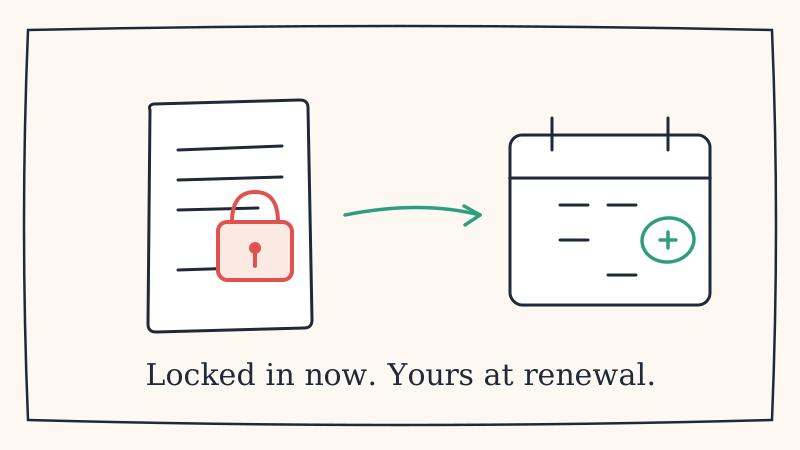
That is one of the most expensive mistakes in outbound. A “we’re under contract” reply is not a rejection. It is a buying signal with a timestamp attached. The prospect did not say your product is wrong for them. They said the timing is wrong, and timing is the one objection that solves itself. Every contract has an end date, and the team that shows up sixty to ninety days before that date with context the prospect already shared is the team that wins the renewal evaluation.
The problem is that capturing and acting on that timing at scale is exactly the kind of work humans are bad at. It requires remembering a detail from a single email months later, tracking it against a calendar, and re-engaging at a precise moment across hundreds of leads. AI reply agents are built for this. Here is how to configure one to turn incumbent-contract replies into a scheduled pipeline instead of a graveyard.
Why ‘Under Contract’ Is the Most Misread Reply in Outbound
Sales teams are trained to chase open opportunities and discard closed ones. A contract objection feels closed, so it gets discarded. But the economics of incumbent-contract replies are unusually good for three reasons.
The prospect has already qualified themselves. They are using a product in your category. They have a budget line for it, an owner responsible for it, and a renewal decision on the calendar. Compared to a true cold prospect, an under-contract reply represents someone who has done most of the work of becoming a buyer. They simply have not become your buyer yet.
Incumbent dissatisfaction grows over time, not down. The day a prospect signs with a competitor is the day they are most committed to that choice. As the contract runs, friction accumulates: missing features, support frustrations, price increases at renewal. A prospect who is mildly indifferent today may be actively shopping in eight months. Showing up at renewal catches them at the peak of that openness.
Almost nobody else follows up correctly. The competitor who sold them assumes the renewal is automatic. Other vendors who got the same “under contract” reply marked it closed-lost like everyone else. If your AI reply agent is the one system that resurfaces at the right time with the right context, you are often the only alternative in the room when the evaluation finally opens.
The catch is that none of this matters if the timing detail is lost. A reply that says “we just renewed in March” is worthless if no human or system remembers it in January.
What Your AI Reply Agent Needs to Detect
Incumbent-contract language is varied and usually buried inside a broader reply. Your agent needs to recognize the pattern and, critically, extract any timing information attached to it.
Common phrasings to detect:
- Explicit lock-in: “We’re under contract with [vendor] through Q3,” “We just signed a two-year deal,” “We’re committed until next year.”
- Soft lock-in: “We already use something for this,” “We have a solution in place,” “We’re happy with our current provider.”
- Timing-rich replies: “Our contract is up for renewal in October,” “We re-evaluate vendors every January,” “Reach back out in the spring.”
- Conditional openings: “Maybe when our agreement ends,” “If things change at renewal, I’ll keep you in mind.”
The most valuable subtype is the timing-rich reply, because the prospect has handed you the exact re-engagement date. Your agent should parse phrases like “renews in October,” “up in Q1,” or “ends next March” and convert them into a concrete future trigger. When no explicit date is given, the agent should still capture the soft signal and either ask a single low-friction follow-up question or assign a sensible default re-engagement window, typically nine to twelve months out for an annual contract.
This is where a Unified Inbox with purpose-built AI inbox agents like Underfive earns its place over a generic autoresponder. The job is not to fire back a canned message. It is to read intent, extract a structured field (renewal date), and schedule a future action against it, all without an SDR touching the thread.
Configuring the Response Workflow
Step 1: Respond Gracefully and Stay in the Relationship
The immediate reply should do one thing well: accept the timing without pushing, and earn the right to come back. A prospect who feels respected when they say “not now” is far more likely to take your call at renewal than one who got hit with a pushy rebuttal.
Keep the acknowledgment short. Thank them, confirm you will not keep selling against an active contract, and ask one optional clarifying question if the renewal timing was vague. Two or three sentences is plenty. The goal is a positive last impression, not a second pitch.
Step 2: Extract and Store the Renewal Trigger
This is the step that separates a reply agent from an inbox. The agent should write the renewal timing into your CRM as a structured field, not bury it in a note. Set a re-engagement task or sequence enrollment dated to roughly sixty to ninety days before the renewal, which is when most vendor evaluations actually begin.
If you log replies to HubSpot or Salesforce automatically, that future trigger becomes a durable part of the record rather than something living in one SDR’s memory. The prospect can change owners, the SDR can leave, and the renewal follow-up still fires on schedule.
Step 3: Keep the Contact Reachable Until Then
A renewal trigger nine months out is only useful if you can still reach the person when it fires. Inboxes change, people switch roles, and email addresses go stale. Before your re-engagement sequence sends, the address should be re-validated so your carefully timed message does not bounce into a void. Running the contact through Scrubby ahead of the re-engagement send protects deliverability and confirms the person is still at the company. A bounced renewal touch is a wasted nine-month wait.
Step 4: Re-Engage With Context, Not a Cold Restart
When the trigger fires, the worst thing your agent can do is send a fresh cold email as if the earlier conversation never happened. The re-engagement message should reference the original exchange: “Earlier this year you mentioned your agreement with [vendor] runs through this fall. As you start thinking about renewal, it might be worth a quick comparison.” That single line of continuity reframes the outreach from cold pitch to helpful, well-timed reminder.
Because the prospect once self-identified as in-market, the re-engagement is closer to a warm follow-up than a cold open. Many teams pair this moment with a low-pressure scheduling offer. Tools like Kali that drop a calendar invite directly into the conversation reduce the friction of going from “I’m open to looking” to a booked evaluation call, which matters most in the narrow window before a renewal decision locks again.
Measuring Whether It Works
Treat incumbent-contract replies as their own pipeline stage, not as closed-lost. Track three numbers:
- Capture rate: the percentage of “under contract” replies where the agent extracted a usable renewal date or window. Early on this may be low because prospects are vague. A single clarifying question from the agent can lift it substantially.
- Re-engagement reach rate: the percentage of scheduled re-engagements that actually deliver to a valid inbox. This is where pre-send validation pays off.
- Reactivation rate: the percentage of re-engaged contacts who book a meeting or re-enter an active opportunity. This is the number that proves the whole motion is worth running.
A team sending meaningful outbound volume will accumulate hundreds of these replies a year. If even a fraction convert at renewal, a category of leads that used to be deleted becomes one of the most efficient sources of pipeline you have, because the qualification work was already done months earlier.
The Takeaway
“We’re locked into a contract” is not the end of a conversation. It is the start of a scheduled one. The reason most teams never capture that value is operational, not strategic: nobody can reliably remember a one-line timing detail across hundreds of leads and act on it months later. That is precisely the gap an AI reply agent closes. It reads the intent, extracts the renewal date, keeps the contact warm and reachable, and shows up at the exact moment the incumbent’s grip is weakest.
Configure your agent to treat these replies as future pipeline rather than dead ends, and you turn the single most misread response in outbound into a predictable, compounding source of deals. See how Underfive handles reply detection, timing extraction, and re-engagement automatically so your team stops deleting buying signals that simply have not matured yet.