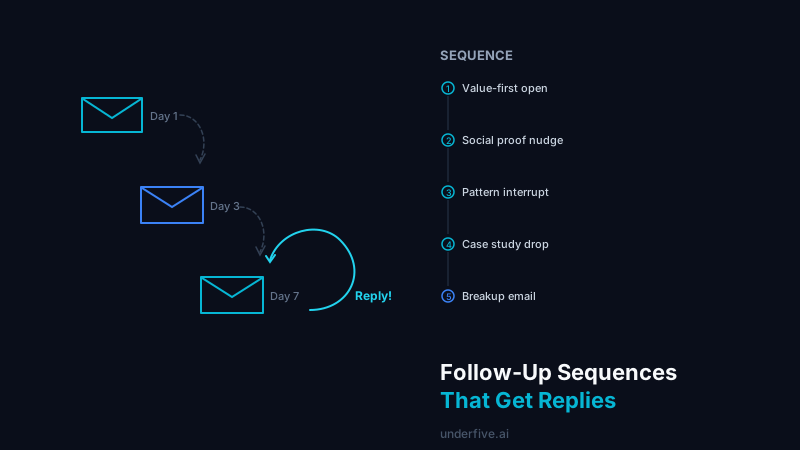
5 Cold Email Follow-Up Sequences That Actually Get Replies in 2026
Here’s a stat that should change how you think about follow-ups: 70% of unanswered cold email threads end after just one message. Meanwhile, the data consistently shows that the majority of positive replies come on the second, third, or fourth touch.
Translation: most sales teams quit right before the conversation would have started.
But the solution isn’t just “send more emails.” If your follow-up sequence is three variations of “Just checking in,” you’re not persistent — you’re annoying. The cold email follow-up sequences that actually work in 2026 do something different with every touch. Each message earns its place in the inbox by offering a new angle, new proof, or new reason to reply.
Below are five frameworks that are driving real cold email reply rates right now. Each one includes the structure, timing, and example copy you can adapt today.
Why Most Follow-Up Sequences Fail
Before we get into the frameworks, let’s diagnose what’s broken.
The typical follow-up sequence looks like this:
- Email 1: Pitch the product
- Email 2: “Did you see my last email?”
- Email 3: “Just bumping this to the top of your inbox”
- Email 4: “Last chance!”
Every message after the first one is a reminder, not a reason. The prospect didn’t ignore you because they forgot — they ignored you because the first email didn’t compel them to act. Sending the same non-compelling message three more times doesn’t fix that.
Effective email follow-up templates in 2026 treat each touch as a standalone piece of value. If someone only saw email #3 and missed everything else, it should still make sense and still be worth replying to.
Sequence 1: The Value Ladder
Best for: Complex B2B products where prospects need education before they buy.
Structure: Each follow-up escalates the specificity and relevance of the value you’re offering. You start broad and get increasingly targeted.
Timing: Day 1, Day 3, Day 7, Day 14, Day 21
The emails:
Email 1 (Day 1) — The Industry Insight
Subject: [Prospect’s industry] teams are losing 11 hours/week on this
Hi [Name],
We just published research on how [industry] teams spend an average of 11 hours per week on [problem your product solves]. The top 10% have cut that to under 2 hours.
The difference isn’t headcount — it’s process. Happy to share the breakdown if you’re curious.
Email 2 (Day 3) — The Specific Metric
Subject: re: [previous subject]
One thing that stood out from that research: the teams saving the most time all automated [specific workflow]. The average ROI was 4.2x within 90 days.
Is [specific workflow] something your team handles manually right now?
Email 3 (Day 7) — The Peer Example
Subject: How [similar company] solved this
[Similar company in their space] was dealing with the same [problem]. They cut [metric] by [percentage] in [timeframe] by changing their approach to [workflow].
Would a 5-minute walkthrough of what they did be useful?
Email 4 (Day 14) — The Direct Offer
Subject: Quick question for [Name]
I’ve been sharing general data, but I’d rather show you something specific to [their company]. I put together a quick analysis of how [their company] could [specific outcome].
Worth 10 minutes this week?
Email 5 (Day 21) — The Graceful Close
Subject: Should I close this out?
I don’t want to be the person clogging your inbox. If the timing isn’t right, totally get it — just say the word and I’ll check back in [timeframe].
If you’re still curious, I’m here.
Why it works: Each email offers a new data point or perspective. The prospect never feels nagged — they feel informed.
Sequence 2: The Social Proof Waterfall
Best for: Markets where trust is the primary barrier. Fintech, healthcare, enterprise.
Structure: Every follow-up introduces a new proof point: a customer, a result, a third-party validation.
Timing: Day 1, Day 4, Day 8, Day 15
The emails:
Email 1 (Day 1) — The Bold Claim + One Proof
Subject: [Competitor type] teams are switching to this
Hi [Name],
[X number] of [their type of company] moved to [your solution] in the last [timeframe]. The average result: [specific metric improvement].
[One-liner customer quote].
Worth a look?
Email 2 (Day 4) — The Case Study
Subject: [Similar company]‘s results after 90 days
Thought this would be relevant — [similar company] had the same [problem] your team likely deals with. After switching their approach:
- [Metric 1] improved by [X%]
- [Metric 2] dropped by [X%]
- Time to [outcome] went from [X] to [Y]
Full story takes 3 minutes to read. Want me to send it over?
Email 3 (Day 8) — The Third-Party Validation
Subject: [Industry publication] covered this last week
[Publication or analyst] just published a piece on [trend relevant to your product]. Key takeaway: teams that [do the thing your product enables] are seeing [X%] better results than those that don’t.
We’re cited in the report. Happy to forward the relevant section.
Email 4 (Day 15) — The Peer Pressure Close
Subject: Your competitors might be ahead on this
I don’t usually play this card, but [2-3 companies in their space] are already using [your approach/product] for [use case]. Figured you’d want to know before the gap widens.
Open to a quick conversation about it?
Why it works: You’re not asking them to trust you — you’re showing them that others already do. Each email makes the proof more specific and harder to dismiss.
Sequence 3: The Problem-Agitation Sequence
Best for: Prospects who don’t yet realize they have a problem worth solving.
Structure: Email 1 names the problem. Each follow-up makes the cost of inaction clearer and more personal.
Timing: Day 1, Day 3, Day 6, Day 10, Day 17
The emails:
Email 1 (Day 1) — Name the Problem
Subject: The [X] problem nobody talks about
Hi [Name],
Most [job title]s I talk to don’t think of [problem] as a priority — until they realize it’s costing them [specific metric: hours, revenue, deals].
Quick question: how is your team currently handling [specific workflow]?
Email 2 (Day 3) — Quantify the Cost
Subject: This adds up faster than you’d think
Did some quick math: if your team has [X] reps handling [workflow] manually, that’s roughly [Y hours/month] spent on something that doesn’t move the needle.
At your team’s average cost, that’s about [$Z/month] in productivity lost.
Not trying to be dramatic — just wanted to put a number on it.
Email 3 (Day 6) — Show the Ripple Effects
Subject: The second-order effects of slow [process]
The direct time cost is one thing. But teams that handle [process] manually also see:
- Slower response times (which kill cold email reply rates — prospects go cold within hours)
- Inconsistent follow-up quality across reps
- Missed signals that could have converted
Tools like Underfive exist specifically because this problem compounds. When replies sit in an inbox for 6+ hours, the window closes.
Email 4 (Day 10) — The “What If” Reframe
Subject: What would change if this was automated?
Imagine your team’s [workflow] was handled in under 5 minutes instead of [current timeframe]. What would your reps do with those reclaimed hours?
That’s not hypothetical — it’s what [customer] did, and they booked [X%] more meetings in the first month.
Email 5 (Day 17) — The Decision Point
Subject: Two options
At this point, there are really two paths:
- Keep handling [process] the current way and accept the costs we’ve been discussing
- Spend 15 minutes seeing if there’s a better approach
Either way is fine. But if you’re even slightly curious, [calendar link] — pick a time that works.
Why it works: You’re educating, not pitching. By the time you make the ask, the prospect has internalized the problem.
Sequence 4: The Reply-Optimized Micro Sequence
Best for: High-volume outbound where you need maximum cold email reply rates with minimal friction.
This is the shortest framework — just three emails. Each one is under 50 words. The goal isn’t to explain your product. It’s to start a conversation.
Timing: Day 1, Day 2, Day 5
The emails:
Email 1 (Day 1) — The One-Liner
Subject: Quick question, [Name]
Who handles [specific function] at [Company]? Wanted to share something relevant but want to make sure it reaches the right person.
Email 2 (Day 2) — The Bump
Subject: re: Quick question, [Name]
Figured this might have gotten buried. Just trying to find the right person for [topic] at [Company]. Would that be you?
Email 3 (Day 5) — The Value Tease
Subject: re: Quick question, [Name]
Last try — [similar company] just [achieved specific result] with a new approach to [their workflow]. Thought it might be relevant for [Company].
Worth a 5-min chat?
Why it works: Short emails are low-commitment. The prospect can reply with a name, a “yes,” or a “not me” — all of which move the conversation forward.
Pro tip: When replies come in fast from a micro sequence like this, speed matters. If you’re running high-volume outbound, a Unified Inbox with AI inbox agents like Underfive can classify and respond to incoming replies within minutes — before the prospect goes cold. That speed gap between a 2-minute reply and a 2-hour reply is often the difference between a booked meeting and a lost opportunity.
Sequence 5: The Multi-Channel Breakout
Best for: High-value target accounts where email alone isn’t cutting through.
Structure: The sequence uses email as the backbone but layers in other touchpoints. Each email references or sets up a non-email interaction.
Timing: Day 1 (email), Day 2 (LinkedIn), Day 4 (email), Day 7 (email + voicemail), Day 12 (email)
The emails:
Email 1 (Day 1) — The Opener + LinkedIn Primer
Subject: [Mutual connection] suggested I reach out
Hi [Name],
[Context for why you’re reaching out — keep it relevant and specific].
I also sent you a connection request on LinkedIn — not to spam your feed, just figured it’d be easier to stay in touch there.
Day 2 — LinkedIn Connection + Comment
No email. Connect on LinkedIn. Comment thoughtfully on one of their recent posts. This isn’t a template — it’s genuine engagement.
Email 2 (Day 4) — The LinkedIn Callback
Subject: Saw your post about [topic]
Your take on [topic from their LinkedIn post] was spot-on. We actually see the same pattern with our customers — [brief, relevant insight].
Would love to compare notes. Free for 10 minutes this week?
Email 3 (Day 7) — The Voicemail Follow-Up
Subject: Just left you a voicemail
Hi [Name],
Left a quick voicemail about [one sentence summary]. Know it’s a busy time — if email’s easier, happy to continue here.
[One-liner about the specific value you can offer]
Email 4 (Day 12) — The Final Value Drop
Subject: One last thing before I go quiet
Found this [resource/data point/tool] that’s directly relevant to what [their company] is working on with [initiative]. Figured I’d share it regardless of whether we connect.
[Link or attachment]
If there’s ever a time to chat, you know where to find me.
Why it works: Multi-channel sequences have higher reply rates because they build familiarity. By the time your fourth email lands, the prospect has seen your name in three different places. You’re no longer a stranger in their inbox.
Making These Sequences Actually Work: The Execution Layer
Frameworks are only as good as their execution. Here’s what separates the teams getting 15%+ cold email reply rates from the ones stuck at 3%:
1. Verify Before You Send
None of these sequences matter if your emails don’t reach the inbox. Before launching any campaign, run your list through a verification tool. Scrubby is particularly useful here — it handles risky and catch-all emails that standard verification tools can’t validate, giving you a cleaner list and better deliverability from the start.
2. Respond to Replies Instantly
The window for engaging a warm reply is painfully short. When someone responds to your Day 7 email with “tell me more,” you have minutes — not hours — to keep that momentum alive. This is where AI-powered reply automation like Underfive becomes a force multiplier. It classifies incoming replies by intent, crafts contextual responses, and ensures no warm lead sits unanswered while your rep is in a meeting.
3. Personalize at Scale Without Sounding Like a Robot
Generic personalization (“I see you’re based in San Francisco!”) is worse than no personalization at all. Real personalization references something specific about the prospect’s situation — a recent company announcement, a tech stack choice, a hiring trend. This takes research, but it’s the single biggest lever for cold email reply rates.
4. Track the Right Metrics
Open rates tell you almost nothing useful in 2026 (privacy features have made them unreliable). Focus on:
- Reply rate (aim for 8-15% depending on your market)
- Positive reply rate (the replies that actually move deals forward)
- Meetings booked per 100 emails sent
- Sequence completion rate (are prospects making it to email 3, 4, 5?)
5. A/B Test Ruthlessly
Don’t run five sequences simultaneously and hope for the best. Pick one framework, run it for 2-3 weeks with at least 200 prospects, measure results, then iterate. Change one variable at a time — subject lines, timing gaps, email length, CTA style.
Choosing the Right Sequence for Your Situation
Here’s a quick decision framework:
- Long sales cycle, complex product? Use Sequence 1 (Value Ladder)
- Trust-dependent market? Use Sequence 2 (Social Proof Waterfall)
- Prospects don’t know they have a problem? Use Sequence 3 (Problem-Agitation)
- High volume, need fast replies? Use Sequence 4 (Micro Sequence)
- Strategic target accounts? Use Sequence 5 (Multi-Channel Breakout)
Most teams should start with Sequence 4 (Micro Sequence) for new markets where they’re still learning what resonates, then graduate to Sequence 1 or 2 once they have enough data to build compelling, specific follow-ups.
The Bottom Line
Cold email follow-up sequences in 2026 are about earning attention, not demanding it. Every email in your sequence should pass a simple test: if this was the only email the prospect ever saw from me, would it still be worth reading?
If the answer is no, rewrite it or cut it.
The five frameworks above give you a starting point, but the real work is in the adaptation. Take the structure, plug in your own data, your own customer stories, your own voice — and test relentlessly. The teams winning at outbound right now aren’t the ones with the most sophisticated tech stack. They’re the ones who treat every follow-up as a chance to deliver value, and who respond fast enough to capture interest when it appears.