SDR Handoff Delays Are Killing Your Cold Email Conversions
Your outbound engine is working. The sequences are running. The emails are landing in primary inboxes. Prospects are opening, reading, and replying. Then everything falls apart.
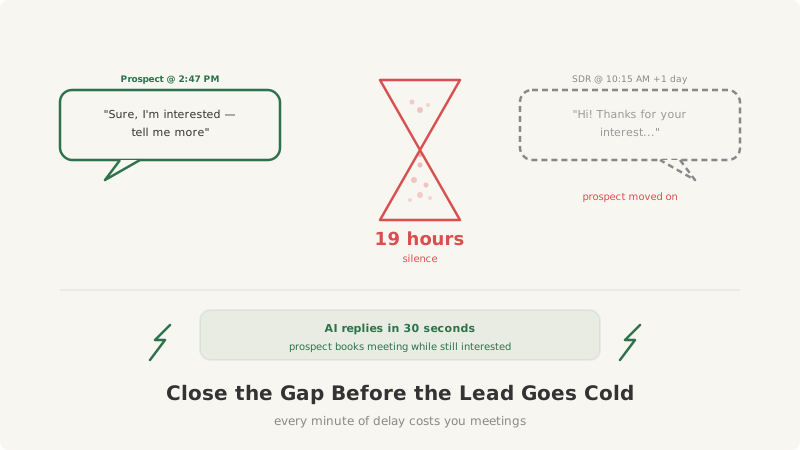
The prospect replies at 2:47 PM saying “sure, happy to take a look — what does pricing look like?” Your SDR is on a discovery call with another lead. They do not see the reply until 4:30 PM. They draft a response, realize they need to check pricing details, get pulled into a team standup, and finally send a reply at 10:15 AM the next day — 19 hours after the prospect expressed interest.
By then, the prospect has received three other vendor emails, had a conversation with a competitor who replied in under five minutes, and mentally moved on from your thread. Your SDR’s carefully crafted response gets a “thanks, we’re actually going in a different direction” reply, or worse, no reply at all.
This is not a hypothetical scenario. This is the default behavior of nearly every outbound sales team that relies on human SDRs to manage reply handling. And it is silently destroying conversion rates at the exact moment when conversion is most likely.
The Data on Reply Speed Is Not Subtle
The relationship between response time and lead conversion has been studied extensively, and the results are consistent across every dataset.
Leads contacted within 5 minutes of expressing interest are 21 times more likely to enter the sales cycle compared to leads contacted after 30 minutes. After 60 minutes, the probability of qualifying a lead drops by more than 10x compared to that 5-minute window. After 24 hours, you are essentially cold-calling someone who was once warm.
These numbers were originally established for inbound leads, but the dynamics are identical — arguably more severe — for cold email replies. An inbound lead who filled out a form on your website has already demonstrated sustained interest. They navigated to your site, read your content, and actively requested contact. Even if you respond slowly, they remember why they reached out.
A cold email reply is different. The prospect was interrupted during their day by your outreach. Something in your email resonated enough to trigger a response, but the momentum is fragile. They were not planning to evaluate your product today. They replied on impulse, and that impulse fades fast.
Every minute between their reply and your response is a minute for them to:
- Get pulled back into their actual priorities
- Receive and engage with a competitor’s outreach
- Forget the specific thing that caught their attention in your email
- Develop buyer’s remorse about engaging with yet another vendor
Where the Handoff Actually Breaks Down
The problem is not lazy SDRs. It is structural. The handoff from “prospect replied” to “SDR responds” has multiple failure points that compound.
Timezone mismatches. If your SDR team is based on the US East Coast and your prospect is in California, a reply sent at 5 PM Pacific arrives at 8 PM Eastern. Your SDR sees it the next morning. That is a 14-hour minimum gap built into your process by geography alone. For teams targeting global accounts, the gaps are even wider.
Notification fatigue. SDRs who manage 50-100 active prospects simultaneously receive a constant stream of notifications — new replies, bounces, out-of-office responses, unsubscribes. The signal-to-noise ratio is terrible. A hot reply from an interested VP gets the same notification priority as an auto-response from an admin assistant. By the time the SDR triages their inbox, the hot reply is buried.
Context switching costs. SDRs are not sitting idle waiting for replies. They are writing new sequences, researching prospects, making calls, and attending meetings. When a reply arrives, the SDR has to stop what they are doing, recall the context of that specific prospect and sequence, craft an appropriate response, and send it. That context switch takes 5-10 minutes even for an experienced SDR. If they are in a meeting or on a call, the delay stretches to hours.
Qualification uncertainty slows responses. Not every reply is straightforward. When a prospect asks about pricing, integrations, or specific use cases, the SDR may need to check with product marketing, consult internal documentation, or loop in an AE before responding. Each additional person in the response chain adds latency.
Weekends and holidays create black holes. A prospect who replies on Friday afternoon at 4 PM will not hear back until Monday morning at the earliest. That is 60+ hours of silence. In enterprise sales, Friday afternoon is actually one of the more productive times for cold email engagement because executives are clearing their inbox before the weekend. All those Friday replies are left hanging.
The Compounding Cost of Slow Replies
The damage from slow reply handling is not just the individual deals you lose. It compounds across your entire outbound operation in ways that are hard to measure but significant.
Your positive reply rate becomes a vanity metric. If your cold email sequences generate a 3% positive reply rate — which is solid — but you only convert 30% of those replies into meetings because of response delays, your effective meeting-booked rate is 0.9%. That is indistinguishable from a team with a 1.5% positive reply rate that converts 60% of replies by responding instantly. The reply was never the goal. The meeting was.
Prospect perception of your company degrades. A fast reply signals competence, urgency, and professionalism. A slow reply signals disorganization or disinterest. If a prospect is evaluating three vendors and one responds in 3 minutes while the other two take hours or days, that speed differential communicates something about each company’s operational capability. The fast responder is not just first — they appear more credible.
Your email data becomes unreliable. When you analyze sequence performance, slow reply handling contaminates your data. A sequence that generates strong interest but weak meeting conversion looks like a messaging problem, but it is actually an operational problem. Teams spend months A/B testing subject lines and email copy when the real lever is response speed.
SDR morale drops. There is nothing more demoralizing for an SDR than crafting a great response to a warm reply and receiving silence in return. They know the prospect was interested. They know the delay was the problem. But the metric still shows an unbooked meeting against their quota.
Fixing the Handoff With Automated First Response
The solution is not to hire more SDRs across more timezones. That is just throwing headcount at a structural problem. The solution is to remove the human bottleneck from the first response.
A Unified Inbox with AI inbox agents like Underfive monitors your outbound email replies in real time and responds within seconds of a prospect’s message landing. Not minutes. Not hours. Seconds.
Here is how the automated handoff works in practice:
Prospect replies with interest: “Looks interesting, tell me more about how this works with our existing CRM.”
AI reply agent responds within 30 seconds: Provides a concise, accurate answer about CRM integration capabilities. Asks a qualifying question to understand their specific setup. Suggests a specific time to connect for a quick walkthrough. Includes a calendar link.
Prospect engages while momentum is high: Because the response arrived instantly, the prospect is still thinking about your product. They click the calendar link. Meeting booked.
SDR takes over for the actual meeting: The SDR sees the booked meeting with full context — the original sequence, the prospect’s reply, the AI’s response, and any additional information the prospect shared. They walk into the meeting prepared.
The critical insight is that the first response does not need to be from a human to be effective. It needs to be fast, relevant, and actionable. The human adds value in the meeting itself, where rapport, discovery, and relationship-building happen. The human adds almost no value in the initial reply, where speed and accuracy are what matter.
What Changes When Reply Speed Goes to Zero
Teams that implement automated first response see specific, measurable changes in their pipeline metrics.
Reply-to-meeting conversion doubles. The most consistent result is a 2x or greater improvement in the percentage of positive replies that convert to booked meetings. If you were converting 25-30% of interested replies into meetings with human-only handling, automated first response typically moves that to 50-60%.
Total meetings booked increase without more sending. Because you are converting more of the replies you already generate, you book more meetings without sending more emails, warming up more domains, or expanding your prospect list. This is the highest-leverage improvement available to an outbound team because it requires zero additional top-of-funnel investment.
Pipeline quality improves. Prospects who book meetings while still in the “impulse to engage” window tend to be more engaged during the actual meeting. They remember what caught their attention. They come to the call with specific questions rather than the generic “remind me why we’re talking” opener that SDRs hear from prospects who booked days after their initial reply.
SDR time is reallocated to high-value activities. When the AI handles initial replies, SDRs spend less time triaging notifications and drafting first responses. That time is redirected to meeting preparation, account research, and follow-up conversations where their skills actually make a difference.
Building the Full Stack
Automated reply handling does not exist in isolation. It works best as part of an integrated outbound stack where each piece handles what it does best.
Prospect data and validation: Before any sequence launches, validate every email address. Use Scrubby to resolve catch-all addresses that standard verification cannot handle. Invalid addresses never enter the sequence, so bounces never contaminate your sending reputation.
Multi-channel sequencing: Use email as your primary channel with calendar invites via Kali as a mid-sequence escalation. The calendar invite touch often generates the reply that the AI agent then handles instantly.
Pipeline operations: If your outbound is managed by Vendisys, automated reply handling ensures that the pipeline they generate converts at maximum efficiency. The value of outsourced pipeline increases dramatically when replies are handled in real time rather than waiting for human availability.
Competitive intelligence: Use CAM to monitor competitor activity. When a prospect replies mentioning a competitor by name, the AI can respond with relevant differentiation points rather than a generic “let’s set up a call” that ignores their specific concern.
The Gap Is Your Biggest Competitor
Your cold email sequences are probably fine. Your targeting is probably reasonable. Your messaging is probably decent. The biggest threat to your outbound pipeline is not a competitor with better copy or a larger sending infrastructure. It is the gap between when a prospect says “I’m interested” and when someone from your team says “great, here’s what’s next.”
Close that gap. The meetings are already in your reply inbox. You just need to respond before the prospect moves on.